When I began my General Motors career in Strategic Planning…
We believed in 10-year roadmaps. Thick binders, glossy decks, and a “future state” that assumed the world would hold still long enough to catch up.
But here’s the reality: it never did.
And now? AI is changing markets in months, sometimes weeks. The question I hear everywhere is: “If AI makes everything obsolete so fast, has it killed the need for long-term planning?”
The data says no. But it has changed the game.
-
Nearly 40% of global CEOs believe their companies won’t be viable in 10 years without change (PwC, 2024).
-
Long-term firms grew 47% more in revenue and 36% more in earnings than peers (2001–2014) (McKinsey, 2017).
-
70% of investors say companies should keep funding ESG—even if it reduces short-term profits (PwC, 2025).
The evidence is clear: long-term strategy isn’t dead. What’s dead is static strategy.
Executive Summary: The CHC Planning Loop
Long-term planning in an AI-driven world isn’t about predicting the future—it’s about building a loop that adapts.
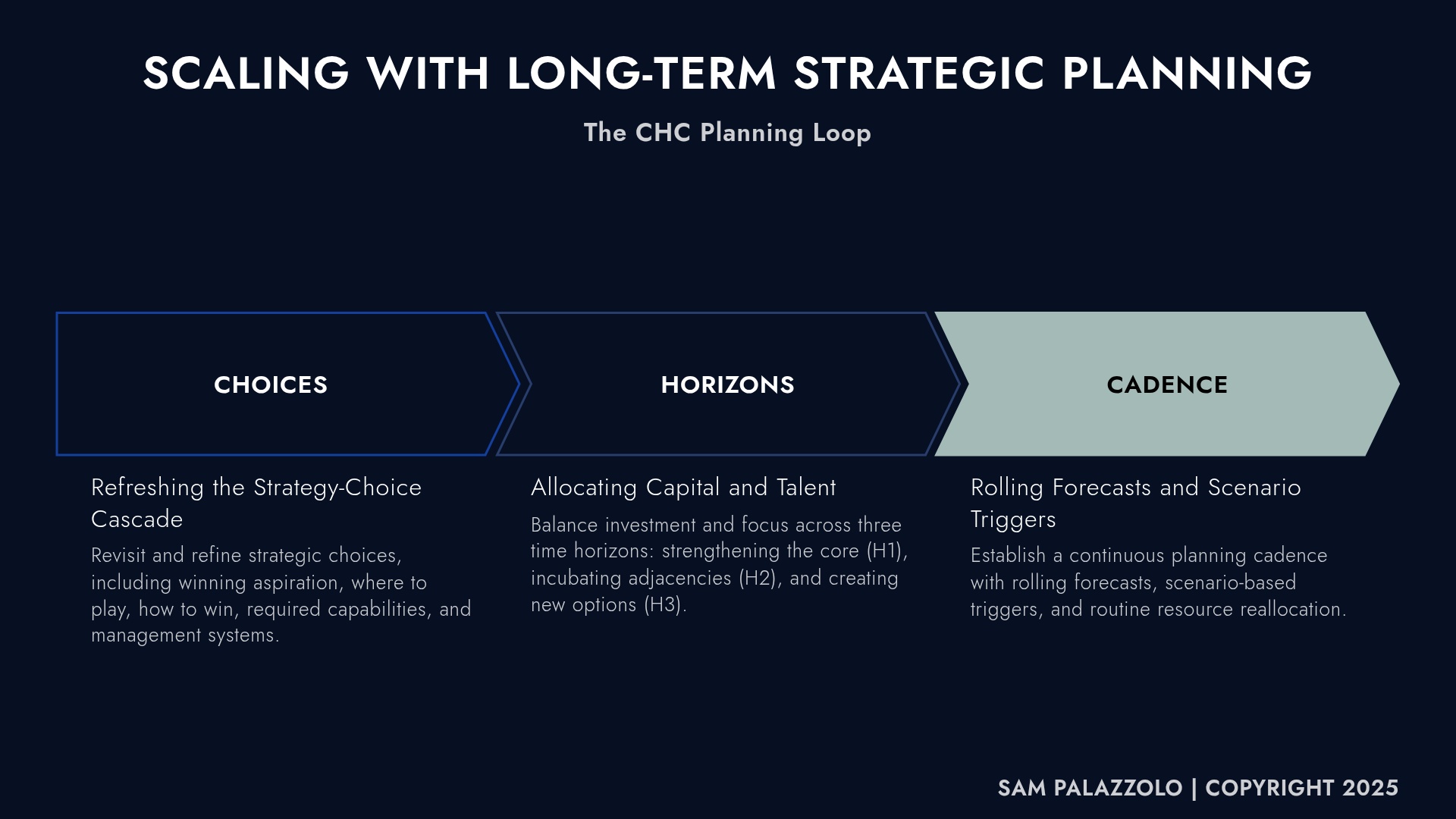
That loop has three parts:
-
Choices – Refresh your strategy-choice cascade: winning aspiration, where to play, how to win, must-have capabilities, and management systems.
-
Horizons – Balance investment across three timelines:
-
H1: Strengthen today’s core
-
H2: Incubate adjacencies (AI pilots fit here)
-
H3: Create future options
-
-
Cadence – Shift from annual cycles to rolling forecasts and scenario triggers. Reallocate capital and talent quarterly—not annually.
This framework (which I call the CHC Planning Loop) turns planning from a one-time exercise into an ongoing operating rhythm.
Real World Example
One client came to me frustrated: their market had shifted under the weight of AI, but their budget was still locked into last year’s assumptions. They were spending millions in areas customers no longer valued—and starving the bets that would define their next three years.
We rebuilt their approach around the CHC Planning Loop:
-
Choices: Reset “where to play” and “how to win,” explicitly clarifying what AI could accelerate—and what it couldn’t.
-
Horizons: Reallocated 20% of capital into H2 initiatives (AI-driven services).
-
Cadence: Installed a rolling 18-month forecast with triggers tied to demand signals and pipeline coverage.
Within six months, they had cut two underperforming initiatives, doubled investment in high-growth adjacencies, and regained confidence in their future.
AI wasn’t the problem. Static planning was.
Real Strategies. Real Results.
So has AI killed long-term planning? No.
But it has killed the lazy version—where we pretend last year’s plan will hold up in next year’s reality. The leaders who win are those who combine long-term vision with short-term adaptability, rebalancing in real time as signals shift.
That’s what the CHC Planning Loop delivers. And it’s why future-proofing isn’t optional anymore.
Sam Palazzolo
Real Strategies. Real Results.
PS – Here’s how I can help right here/right now:
-
Catalyst Audit – Identify if your growth plan is globally ready (and where it’s likely to break) – 5 questions/3 minutes: Take the Audit
-
CEO Catalyst Program – The next CEO Cohort is forming for an October 2 launch – Find out more
-
An Exclusive NYC Executive Dinner – On October 7th I’ll be hosting a transformational executive dinner in NYC – RSVP here


Responses