Most companies don’t realize delegation is breaking until their execution speed collapses. Not because people are incapable, but because the business has outgrown a leadership model built for a smaller stage.
At early revenue levels, leaders can rely on instinct, tribal knowledge, and sheer force of will. But as headcount grows and complexity increases, those same habits quietly become structural liabilities:
-
Leaders retain too many decisions
-
High performers can’t move without approval
-
Teams escalate issues instead of executing
-
Accountability becomes diffuse
-
The organization slows down despite working harder
This week, I ran “Delegation Mastery” from my 50 Scaling Strategies Playbook through an AI pressure test. What emerged was a clear, data-driven blueprint for turning delegation from a personality trait into a scalable operating system.
The Delegation Problem Isn’t Skill — It’s System Design
Delegation issues rarely stem from incompetence. They come from unclear structures, undefined decision rights, and a lack of feedback loops.
AI surfaces these breakdowns with startling clarity:
-
Role ambiguity: multiple leaders owning the same KPI
-
Decision latency: choices bottlenecking at the top
-
Rework: tasks returning upstream due to unclear expectations
-
Low empowerment: managers hesitate because consequences are opaque
-
Leader overload: executives function as doers, not multipliers
These patterns become predictable—and preventable—once the organization sees them through data rather than anecdote.
Designing Delegation as an Operating System
Traditional delegation is episodic: a task assigned here, an approval given there. Scaling organizations require delegation architecture—a structured system that defines who owns what, at what level of autonomy, and under what conditions.
AI enables this by mapping:
1. Delegation Tiers
Centralized, distributed, and adaptive models—each suited to different business contexts.
2. Decision-to-Impact Maps
Which decisions affect revenue flow, and which bottlenecks are causing the largest drag on pipeline velocity.
3. Accountability Chains
Who owns outcomes versus who owns execution—removing political ambiguity.
4. Escalation Logic
What should move upward, what should stay where it is, and what should be automated entirely.
By analyzing communication patterns, performance metrics, and cross-functional workflows, AI builds what amounts to a Delegation Operating Framework—repeatable, scalable, and aligned to growth.
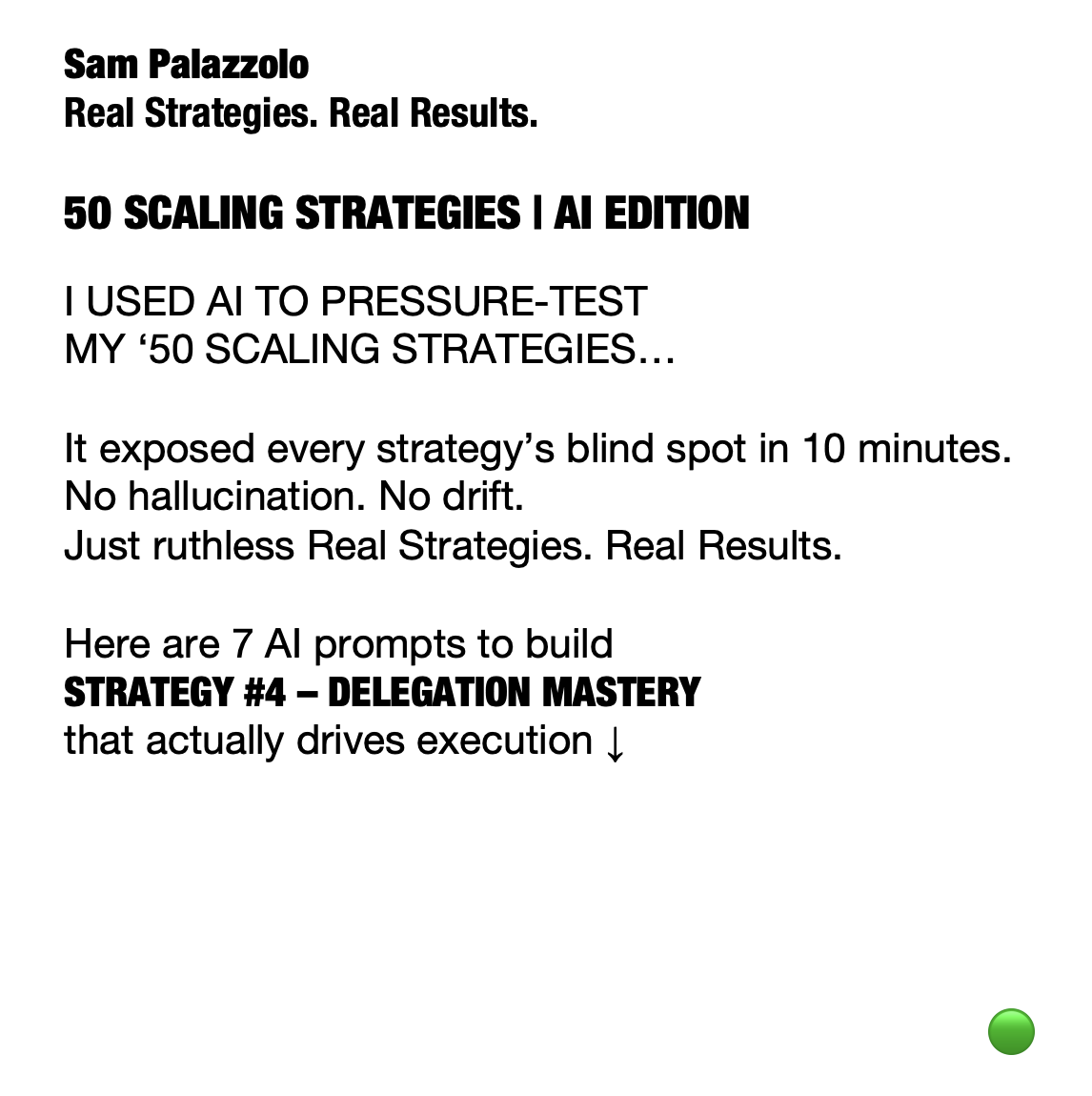
Grab the full carousel: http://javelininstitute.org/wp-content/uploads/2025/11/50-Scaling-Strategies-AI-Edition-4-Delegation-Mastery.pdf
The Leadership Cadence That Makes Delegation Stick
Delegation fails when leaders lack visibility into its performance.
AI solves this by implementing a cadence that monitors execution quality and decision velocity:
-
Weekly Delegation Reports highlight bottlenecks and rework trends
-
Decision Logs track autonomy, speed, and outcome quality
-
AI Signal Alerts flag leadership drift, misalignment, or over-escalation
-
Coaching Prompts help leaders correct under-delegation or over-control
The result is a leadership layer that operates on clarity, not heroics.
Delegation stops being an act of trust—it becomes a system of measurable performance.
Where Delegation Becomes a Competitive Advantage
Most organizations treat delegation as soft management.
AI makes it a strategic moat.
Companies that adopt structured delegation systems consistently outperform peers:
-
Faster cycle times
-
Higher retention among rising leaders
-
Lower rework and decision churn
-
Better alignment between strategy and execution
-
Stronger cross-functional collaboration
The real advantage: senior leaders stop being bottlenecks and become multipliers.
That shift alone alters growth trajectory.
Real Strategies. Real Results.
Delegation Mastery isn’t about handing off tasks.
It’s about designing a leadership system capable of sustaining scale.
AI gives CEOs and executive teams the ability to see where delegation is breaking, where decision authority must evolve, and how to architect a model that accelerates execution rather than slowing it down.
If your team is working harder but navigating decisions slower, it’s not a capacity issue—it’s a system issue.
Fix the delegation architecture, and growth accelerates.
Sam Palazzolo
Real Strategies. Real Results.
PS – Here’s how I can help right here, right now:
1. GTM Operating System | 30-Minute Working Session (Free – $500 Value)
A rapid alignment session to diagnose execution bottlenecks and build cross-functional rhythm.
2. Scale Sprint (90 Days)
A deep operational rebuild designed to accelerate revenue, tighten leadership accountability, and remove execution drag.
3. Interim / Fractional CXO
Hands-on strategic leadership to architect and drive your growth system.


Responses