Let me be blunt: growth isn’t just about bigger numbers—it’s about bigger headaches!
Gallup reports only 31% of employees were engaged in 2024, the lowest in over a decade (Gallup, 2025). Meanwhile, Gartner found that employees’ willingness to support change has collapsed from 74% in 2016 to 38% in 2022 (Gartner, 2023). Bain’s research shows only 11% of companies sustain profitable growth over time (Bain, 2017).
I’ve lived this frustration personally: leaders hit the gas on growth, only to discover the engine rattles under pressure. More initiatives, more layers, more meetings—and suddenly complexity suffocates the very momentum you worked so hard to build. That’s the definition of “growing pains.”
So how do you fix it?
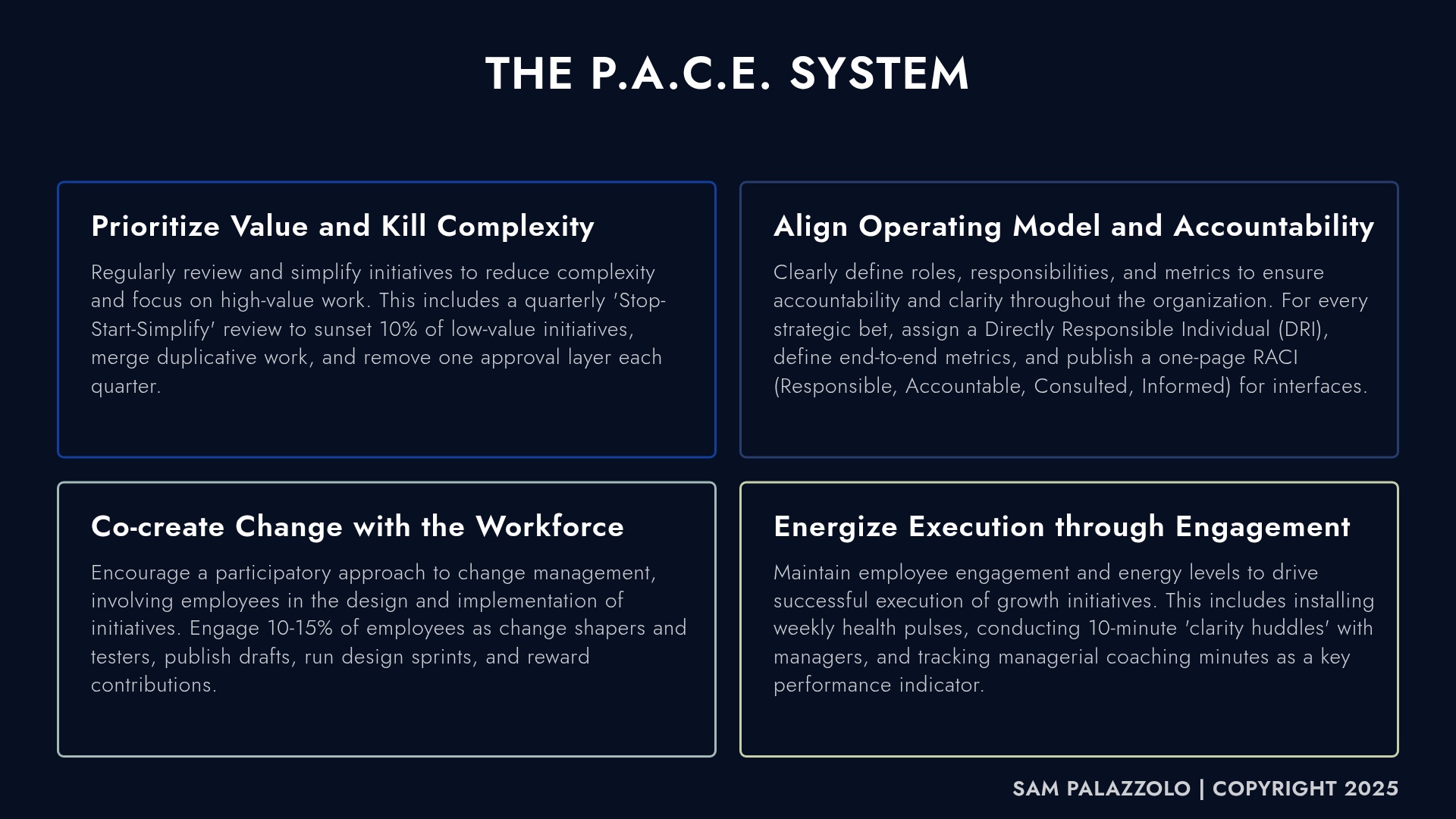
The P.A.C.E. System for Managing Growing Pains
Scale doesn’t break because of lack of opportunity—it breaks because of execution drag. The solution is a rhythm that keeps you aligned, energized, and ruthless about focus. Enter my P.A.C.E. model (inspired by Bain’s “growth ↔ complexity” work, Gartner’s participatory change research, McKinsey’s transformation execution insights, and Gallup engagement trends):
- P — Prioritize Value and Kill Complexity
Run a quarterly Stop-Start-Simplify review. Sunset 10% of low-value work, merge duplicative projects, and strip away one approval layer per quarter. Complexity kills speed—cut it before it cuts you. -
A — Align Operating Model and Accountability
Assign a Directly Responsible Individual (DRI) for every strategic bet. Publish a one-page RACI for interfaces. Clarify end-to-end metrics so ownership doesn’t get lost in the org chart. -
C — Co-create Change with the Workforce
Engage 10–15% of employees as shapers and testers. Run design sprints, publish drafts, and reward contributions. Gartner shows this “open-source” approach makes companies 14× more likely to succeed (Gartner, 2022). -
E — Energize Execution through Engagement
Install weekly health pulses, run 10-minute “clarity huddles,” and track managerial coaching minutes. McKinsey found that transformation programs that fully complete their initiatives report ~79% success (McKinsey, 2021). Engagement is not a “soft” measure—it’s your execution fuel.
Real World Example
One client hit a wall after doubling headcount. Their leadership team was drowning in approvals, employees tuned out of yet another change program, and managers were too busy firefighting to coach their teams.
We applied P.A.C.E. starting with a Stop-Start-Simplify review. In the first 30 days, we eliminated 12 redundant initiatives (hello AI!), reassigned DRIs for three critical growth projects, and introduced weekly clarity huddles. Within 90 days, engagement pulse scores rose by 17%, and cycle time on customer initiatives dropped by 22%.
This wasn’t about working harder—it was about working with rhythm.
Real Strategies. Real Results.
Growth always, always, always brings pain! But pain is a signal, not a sentence. Leaders who adopt a structured system like P.A.C.E. turn growing pains into proof points of progress. Kill complexity, clarify ownership, co-create change, and keep your people energized—and you’ll discover growth doesn’t have to hurt so bad!
Sam Palazzolo
Real Strategies. Real Results.
- PS - Here’s how I can help right here/right now:
-
Catalyst Audit – Identify if your growth plan is globally ready (and where it’s likely to break). 5 questions/3 minutes: Take the Audit
-
CEO Catalyst Program – The next CEO Cohort is forming for an October 2 launch. Details here: CEO Catalyst
-
Exclusive NYC Executive Dinner – October 7th in New York City. Will I see you there? RSVP here: Executive Dinner RSVP


Responses