
Maintaining Company Culture When Everything’s Moving Fast
There’s a graph I keep pinned on my desk: “Toxic culture vs. compensation as a predictor of attrition.” Toxic culture clocks in at 10.4× the predictive power of pay. Ten point four. That stat (from MIT Sloan Management Review) hits me every time because it explains a hundred client conversations in one picture—why teams with market-rate salaries still leak talent, why growth stalls even as budgets expand, and why a handful of corrosive behaviors can outmuscle a dozen well-worded values. (Sull, Sull, & Zweig, 2022)
Here’s the part that frustrates me—and energizes me: we keep trying to fix culture with comms or perks, when the data says fix the behaviors and the systems. Engagement isn’t a vibe; it’s a performance driver. Gallup’s latest meta-analysis ties top-quartile engagement to +23% profit versus bottom quartile (Harter, 2024), while SHRM estimates $223B in five-year turnover costs from poor culture alone (SHRM, 2019). PwC’s global study puts a bow on it: 69% say culture is a competitive advantage and 72% say it enables change (PwC, 2021).
This week’s model—the one we built the infographic and carousel around—is your playbook to turn those numbers into operating
The 4×4 Play to Maintain Culture
To maintain culture at scale, you need a mechanism that converts intent into everyday behavior. The most battle-tested mechanism I’ve found is McKinsey’s Influence Model—four levers that shift mindsets and actions:
-
Understanding & Conviction (clarify the why),
-
Role Modeling (make the new way visible),
-
Skills (teach the behaviors), and
-
Reinforcement (align systems and incentives).
Source: McKinsey, The four building blocks of change.
Below is how to apply it in a simple 4×4 sequence you can implement immediately.
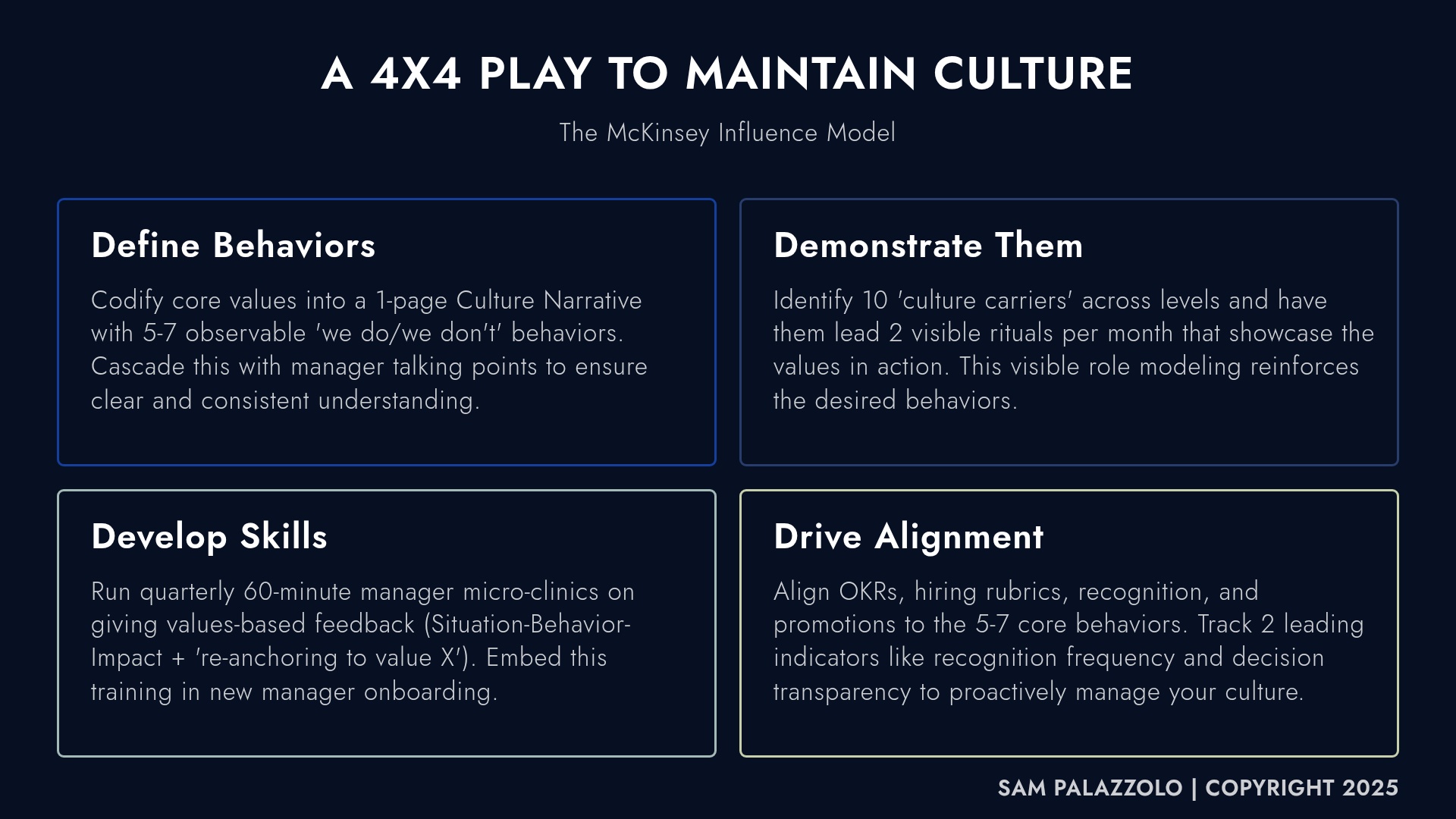
The 4×4 Play — Actionable Steps
1) Define Behaviors (Understanding & Conviction)
Codify your values into a one-page Culture Narrative with 5–7 observable “we do / we don’t” behaviors. Avoid platitudes—write in plain language that passes the “Would we hire/fire/promote on this?” test. Cascade via manager talking points and confirm comprehension with two questions: What changes for us? and What will you stop/start?
Reference: McKinsey Influence Model.
2) Demonstrate Them (Role Modeling)
Identify ~10 culture carriers across levels (not just execs). Ask each to lead two visible rituals per month that showcase values in action—e.g., decision post-mortems that reward transparency, customer story reviews that celebrate ownership, “say-do” reviews where leaders publicly track commitments. When people see it, they mirror it.
Reference: McKinsey Influence Model.
3) Develop Skills (Skills & Coaching)
Run quarterly 60-minute manager micro-clinics on values-based feedback (Situation–Behavior–Impact + “re-anchor to value X”). Teach managers to translate values into interview prompts, onboarding checklists, and project kickoffs. Bake this training into new-manager onboarding to build a consistent coaching language.
Reference: McKinsey Influence Model.
4) Drive Alignment (Reinforcement Mechanisms)
Wire culture into the machine. Align OKRs, hiring rubrics, recognition, promotion criteria to the 5–7 behaviors. Track two leading indicators that predict outcomes before they bite you:
-
Recognition pulses per FTE (are we catching people doing it right?),
-
Decision transparency score (are decisions—and their rationale—visible?).
Reference points for business impact: Gallup, SHRM, PwC.
Real World Example
A leadership team asked why churn was rising despite generous compensation and richer benefits. Exit interviews were vague. We mapped their written values to actual behaviors and systems. Two friction points emerged:
-
Inconsistent manager behavior. Senior leaders preached “candor,” but weekly forums punished dissent.
-
Misaligned incentives. Sales recognition emphasized short-term bookings while the stated value was “customer trust.”
We implemented the 4×4:
-
Define: Rewrote the Culture Narrative into six “we do/we don’t” behaviors; every team discussed what would stop and start next sprint.
-
Demonstrate: Appointed nine culture carriers to run “decision post-mortems” and “voice-of-customer” reads; execs rotated into these sessions to model the behavior.
-
Develop: Managers completed two micro-clinics on SBIs and decision hygiene; we added behavioral interview prompts to recruiting.
-
Drive: Quarterly bonuses included a values multiplier tied to a “decision transparency” pulse and a “customer trust” proxy.
Three quarters later, regretted attrition dropped, time-to-decision improved, and the engagement delta closed. Did perks move the needle? Not really. Behavior + System Alignment did.
Real Strategies. Real Results.
Culture doesn’t scale by osmosis. It scales when you define a few non-negotiable behaviors, demonstrate them in public, develop managers to coach them, and drive alignment by rewarding them. If you remember one thing this week, make it this: the mechanisms you reinforce will beat the messages you repeat.
To ground your work, keep these statistics front and center (and share the links with your team):
-
Toxic culture is 10.4× more predictive of attrition than pay (MIT SMR).
-
Top-quartile engagement teams deliver +23% profit (Gallup).
-
Poor culture cost $223B in five-year turnover (SHRM).
-
Culture is cited as advantage (69%) and change enabler (72%) (PwC).
If you want a ready-to-use blueprint, use the 4×4 Play above—built on the McKinsey Influence Model—for your next leadership meeting.
Sam Palazzolo
Real Strategies. Real Results.
PS - Here’s how I can help right here/right now:
1 - Catalyst Audit – Identify if your growth plan is globally ready (and where it’s likely to break) – 5 questions/3 minutes: https://www.sampalazzolo.com/assessments/2148521795
2 - Catalyst Board – Join an elite peer group navigating similar international scaling challenges – Email me at [email protected] to find out more.
3 - Catalyst Strategy Session – A focused 1:1 engagement to get your global expansion plan aligned and actionable – https://calendly.com/spalazzolo/60-minute-strategic-catalyst-session-with-sam-palazzolo


Responses