If I had a dollar for every time a CEO told me, “We just need better marketing,” I’d have… well, a bigger yacht than I already don’t have.
Here’s the real kicker: It’s not the marketing—it’s the distribution.
I was reviewing a portfolio company last quarter that had incredible demand. Strong product. High engagement. They were doing all the “right” things... and still stuck in neutral.
Why? One distribution channel. One playbook. One dimensional growth.
It’s like owning a five-star restaurant—and only letting customers come in through the kitchen door.
They’re not alone. According to McKinsey, 71% of top-performing companies use more than four distinct distribution channels—including digital, direct, reseller, and partner-led. The result? They grow 3x faster than those who don’t (PwC, 2023) and lower customer acquisition costs by up to 40% in the process (Bain & Company, 2022).
So why do so many leaders stay stuck?
Let’s break it down...
The Executive Breakdown: How to Expand Your Distribution Channels (Without the Chaos)
Strategic distribution doesn’t mean throwing your product on Amazon and hoping for the best. It means aligning your channels to your customers, your goals, and your systems.
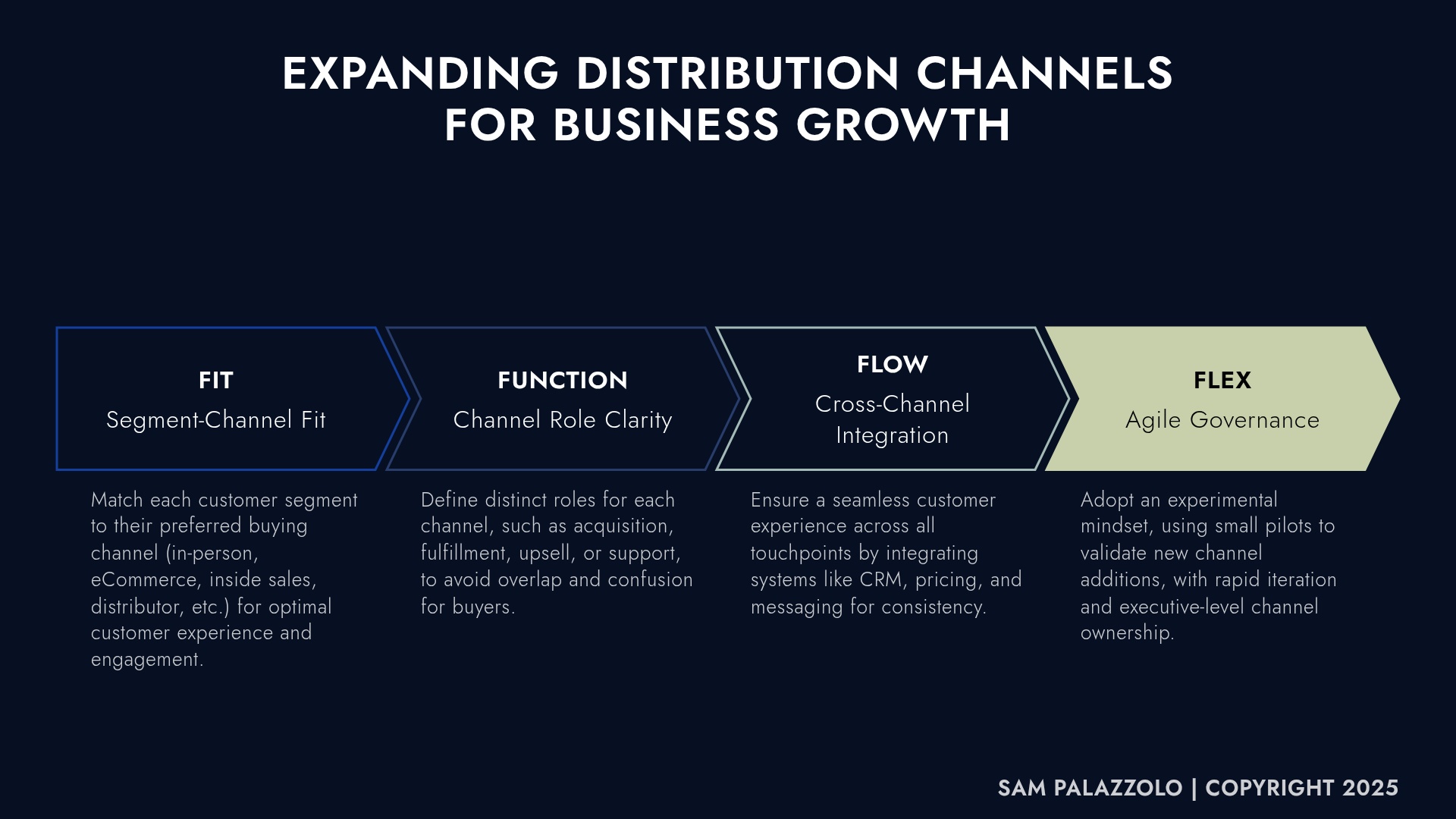
Here’s the model I use with clients (inspired by McKinsey’s omnichannel work):
1. FIT – Segment-Channel Fit
Match each customer segment to their preferred buying channel—whether that’s inside sales, eCommerce, distributor, or direct. The customer decides the battlefield.
2. FUNCTION – Channel Role Clarity
Every channel needs a job: Acquisition. Upsell. Support. Fulfillment. If roles overlap, customers (and your team) will be confused.
3. FLOW – Cross-Channel Integration
If your CRM, pricing, and messaging aren’t unified across channels, expect friction. Growth isn’t just about access—it’s about alignment.
4. FLEX – Agile Governance
Pilot new channels in controlled sprints. Don’t bet the farm. Treat each expansion like an experiment with clear KPIs and executive ownership.
Real World Example
One of my clients—an advanced manufacturing firm—had always relied on direct sales. When they tried launching an eCommerce portal for mid-size buyers, revenue didn’t just stall—it dropped. The internal sales team saw it as competition. Pricing wasn’t consistent. Lead tracking fell apart.
We went back to basics:
-
Defined each channel’s role and how it supported the buyer journey.
-
Created separate incentive structures for internal sales and digital self-service.
-
Built shared dashboards to track customer movement across touchpoints.
Three months later: CAC dropped 28%, lead conversion increased 33%, and partner satisfaction rose across the board.
More channels ≠ more confusion—when you do it right.
Real Strategies. Real Results.
Channel expansion isn’t about doing more. It’s about doing what works, for more customers, with less marginal effort.
It’s one of the most leveraged moves a leader can make. But it requires clarity, discipline, and experimentation—not hope.
If you’ve been stuck with a flat sales curve or watching channel partners underperform, maybe it’s time to rework the model—not the message.
Sam Palazzolo
Real Strategies. Real Results.
P.S. – There’s three ways I can help right here/right now:
1 – Catalyst Audit – Identify if your growth plan is globally ready (and where it’s likely to break) – 5 questions / 3 minutes:
https://www.sampalazzolo.com/assessments/2148521795
2 – Catalyst Board – Join an elite peer group navigating similar international scaling challenges – Email me at [email protected] to find out more.
3 – Catalyst Strategy Session – A focused 1:1 engagement to get your global expansion plan aligned and actionable:
https://calendly.com/spalazzolo/60-minute-strategic-catalyst-session-with-sam-palazzolo



Responses