When was the last time you launched something new that actually moved the needle?
I’ve seen it too often: leaders grind away on incremental tweaks while their competitors leapfrog with products no one saw coming. It’s frustrating to watch—and I’ve been guilty of it myself.
McKinsey found that 1 in 5 top-performing organizations generate 21% of their revenue from products or services that didn’t even exist a year earlier—almost double their peers (McKinsey, 2021). Yet over25% of revenue and profit comes from new launches, while 50% of those launches fail to hit their targets. The math is simple: innovation drives growth, but most leaders still get it wrong.
I know the temptation: more meetings, bigger committees, endless refinement. Meanwhile, the market keeps moving.
The Framework That Separates Doers from Dreamers
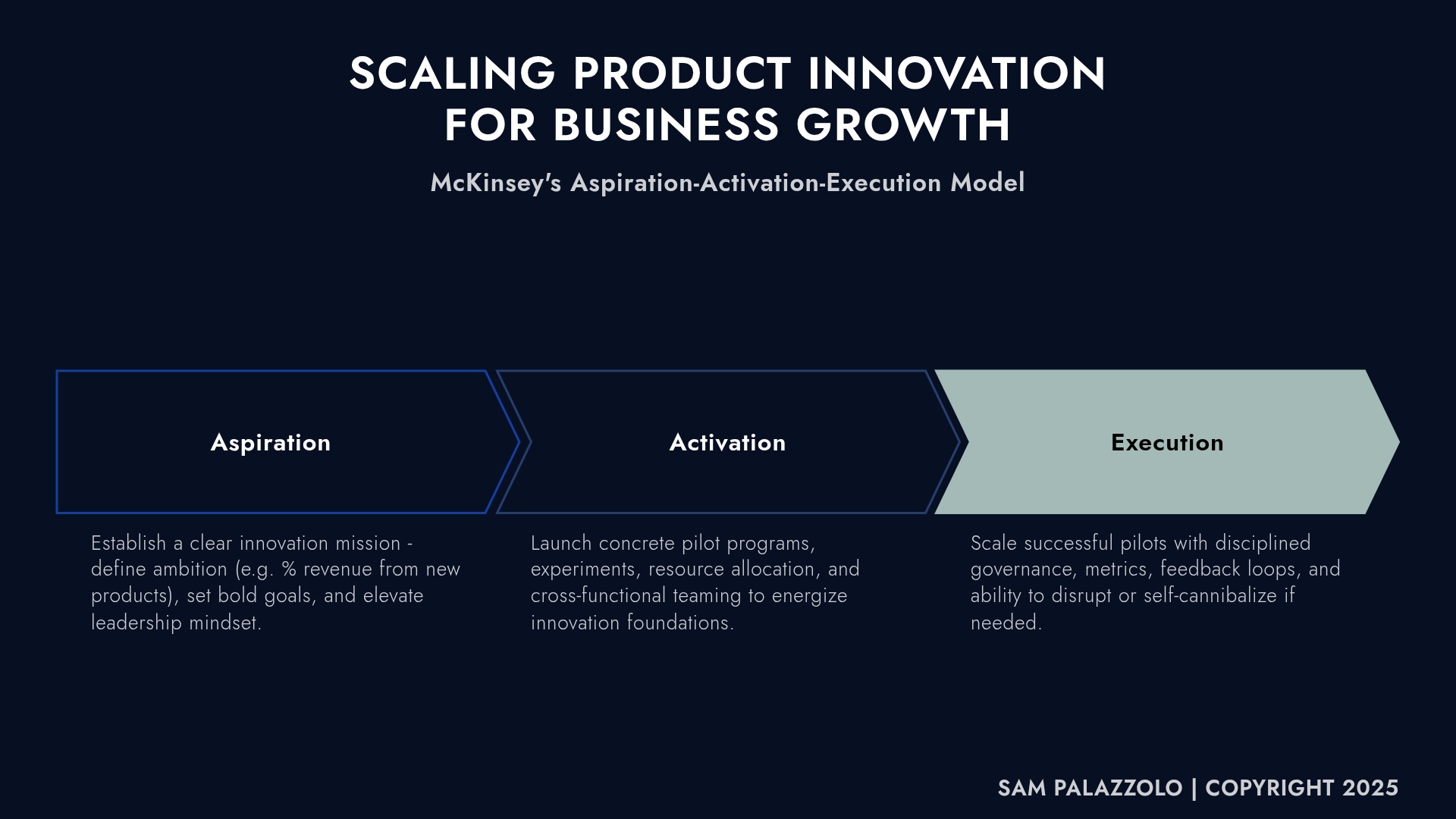
For leaders ready to turn innovation into a real growth engine, McKinsey’s Aspiration–Activation–Execution model offers a way forward:
-
Aspiration
Set a bold innovation mission. Define where you expect future revenue to come from (new products, adjacent markets), set measurable targets, and elevate leadership’s ambition. -
Activation
Launch pilot programs and experiments. Allocate resources to sm -
all, cross-functional teams that can validate promising ideas quickly without bureaucracy slowing them down.
-
Execution
Scale what works—fast. Use governance, feedback loops, and clear metrics to grow successful pilots while being willing to disrupt or even cannibalize existing offerings.
This isn’t theory. It’s a disciplined approach to ensure innovation leads to impact, not just ideas.
Real World Example
A client came to me stuck in the classic trap: their pipeline ofideas was full, but nothing made it to market. Their “innovation committee” had become a black hole. We reframed the approach using this model:
-
Aspiration: We defined a clear target: 15% of next year’s revenue must come from products launched within the past 18 months.
-
Activation: Built three small teams with authority to run pilots. In 90 days, they validated five ideas and killed six others—no hard feelings.
-
Execution: The winners? A service add‑on and a digital tool that both reached paying customers in under six months.
The result: energy returned to the culture, and innovation shifted from “someday” to a pipeline of tangible wins.
The Hard Truth
Product innovation is not about chasing shiny objects. It’s about building a repeatable system that forces focus on bold goals, disciplined testing, and decisive scaling.
 Real Strategies. Real Results.
If your innovation feels like a buzzword instead of a growth driver, you’re not alone. The leaders who thrive are those who replace “random acts of innovation” with a clear framework and the discipline to act on it.
That's it for this week...
Sam Palazzolo
Real Strategies. Real Results.
PS – Here’s how I can help right here/right now:
1 – Catalyst Audit – Identify if your growth plan is globally ready (and where it’s likely to break) – 5 questions/3 minutes:
https://www.sampalazzolo.com/assessments/2148521795
2 – Catalyst Board – Join an elite peer group navigating similar international scaling challenges – Email me at [email protected] to find out more.
3 – Catalyst Strategy Session – A focused 1:1 engagement to get your global expansion plan aligned and actionable –
https://calendly.com/spalazzolo/60-minute-strategic-catalyst-session-with-sam-palazzolo



Responses