A few quarters ago, I asked a leadership team a simple question: “What’s the fastest way to widen your idea surface area without adding headcount?”
They gave me the usual answers—more tools, better meetings, an offsite. None were wrong. But the lever that consistently moves the needle isn’t glamorous: it’s who gets in the room and who feels safe to speak once they’re there.
Here’s why this is more than a values conversation—it’s a performance conversation:
-
Companies in the top quartile for gender diversity on executive teams are 25% more likely to outperform on profitability (association, not causation). (McKinsey, 2020)
-
Ethnic/cultural diversity at the executive level? That top quartile shows a 36% higher likelihood of profitability. (McKinsey, 2020)
-
Firms with above-average leadership diversity generate 19 percentage points more revenue from innovation (45% vs. 26%). (BCG, 2018)
-
And 76% of candidates say a diverse workforce matters when evaluating employers. (Glassdoor, 2020)
If you’re feeling a mix of excitement (“we’re leaving money and talent on the table”) and frustration (“we’ve tried initiatives before and they stalled”)—you’re not alone. The difference between performative and productive is how you operationalize D&I.
From Principles to Playbook: A Practical Model You Can Run
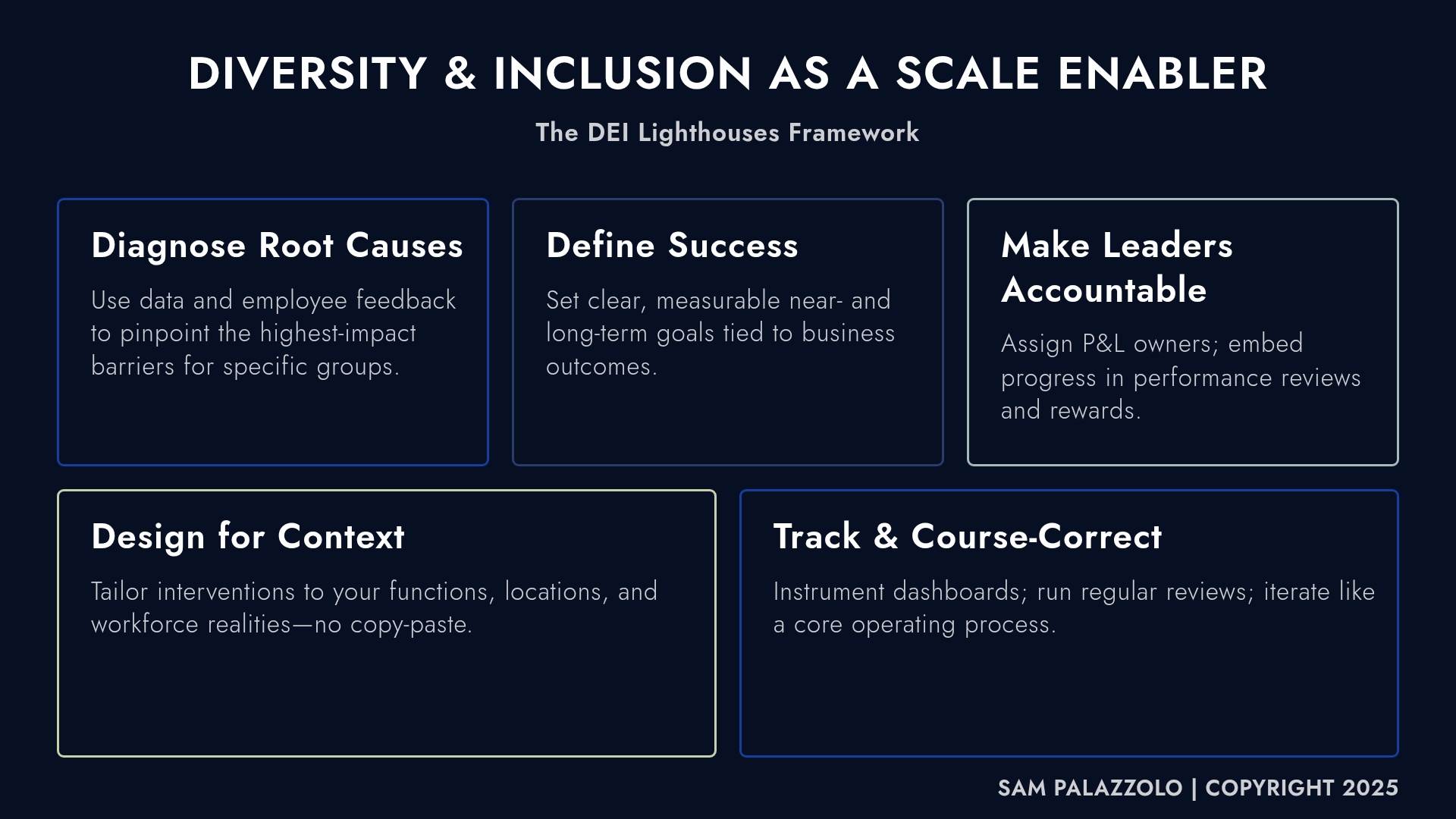
Treat D&I like a revenue program—owned by the business, instrumented with metrics, and reviewed in the same operating rhythm. The most credible, field-tested model I’ve found is the Global Parity Alliance / McKinsey DEI “Lighthouses” approach, distilled to five execution factors. (WEF & McKinsey, 2023) | (McKinsey overview)
The DEI “Lighthouses” Five-Factor Execution Framework
-
Diagnose root causes
Get specific: use quantitative data and employee voice to identify the real barriers for particular groups (role, level, location).
Why it matters: Generic initiatives miss local blockers and underdeliver. -
Define success
Tie goals to business outcomes—e.g., product velocity, innovation revenue, attrition in key roles—with time-bound targets. -
Make leaders accountable
Put ownership with P&L leaders (not just HR). Bake progress into performance reviews and compensation. -
Design for context
Calibrate interventions to the realities of each function and region. One-size-fits-all ≠ results. -
Track & course-correct
Stand up a visible dashboard; review monthly like you would pipeline or OKRs; iterate or kill tactics quickly.
Leader behavior multiplier: Coach the top team on the six signature traits of inclusive leadership—commitment, courage, cognizance of bias, curiosity, cultural intelligence, and collaboration. (Deloitte, 2016)

How to Run This Playbook (in 30 Days)
Don’t boil the ocean. Stand up one Lighthouse in a single role family where diversity and inclusion drive measurable value (e.g., product, sales engineering, clinical ops, store managers—pick your leverage point).
Week 1 — Diagnose & Define
-
Pull three years of data cut by role/level/location: hiring slates, offers, promotion velocity, pay bands, exit interviews.
-
Run a quick inclusion pulse (belonging, fairness, openness to voice) for that org.
-
Set one numeric target that ties to business outcomes (e.g., increase representation of X role from 18% → 28% in 12 months; reduce attrition by 4 pts in the same window).
-
Use the innovation and profitability correlations to frame the business case. (McKinsey, 2020) (BCG, 2018)
-
Week 2 — Assign Ownership & Instrument
-
Name a single accountable business leader; document responsibility and incentives.
-
Instrument the funnel:
-
Attract: require structured, diverse slates for each opening.
-
Select: standardized rubrics; panel diversity; work-sample assessments where feasible.
-
Advance: quarterly promotion parity reviews and sponsorship commitments.
-
Experience: monthly pulse on inclusion drivers; post-mortems on regrettable attrition.
-
Week 3 — Skill the Leaders
-
Run a 60-minute session on the six inclusive leadership traits with one behavioral commitment per leader for 30 days (e.g., “one dissent-first question per meeting”). (Deloitte, 2016)
Week 4 — Publish & Review
-
Launch a simple DEI Lighthouse dashboard (goal, actions, deltas).
-
Schedule a monthly review in the same operating cadence as revenue / product—because it is a growth lever. (WEF & McKinsey, 2023)
Reminder on evidence: The profitability and innovation stats show correlation, not guaranteed causation. But the direction and persistence across multiple studies make this a high-conviction bet—especially when you run it as a disciplined operating system!
Real World Example
The Problem: A leadership team believed they had a “pipeline issue” for senior product roles. Recruiting cycled through the same networks; the team lacked diverse perspectives; roadmap debates were echo chambers.
What We Did (Lighthouse approach):
-
Diagnose: Data showed the real break was at the promotion stage, not top-of-funnel. Women and underrepresented talent were receiving higher stretch assignments but slower sponsor advocacy when promotion committees met.
-
Define: Target: improve promotion velocity by 25% for underrepresented groups in senior product roles within 12 months; secondary target: lift innovation revenue contribution from new product lines. (We referenced the BCG innovation finding to galvanize commitment.) (BCG, 2018)
-
Own: The product GM—not HR—was accountable; part of bonus tied to target.
-
Design: Introduced structured promotion rubrics, sponsor assignments (named advocates), and a dissent-first review practice in roadmap meetings to broaden idea intake.
-
Track: Quarterly dashboard; monthly leadership review; fast-cycle adjustments.
The Result (12 months): Promotion parity achieved, regrettable attrition dropped, and the team shipped two features sourced from dissent-first sessions that materially improved NPS and win-rates. Was it all because of D&I work? No—but the combination of diverse voices and inclusive operations expanded the idea surface area in a way the old system never did.
Real Strategies. Real Results.
If you remember one thing: D&I is a scale strategy. It widens your candidate funnel, elevates decision quality, and expands innovation—when you make it a business-owned, instrumented operating process, not a poster on the wall.
Use this week’s framework:
-
Pick one role family.
-
Stand up one Lighthouse (See lighthouse image for inspiration).
-
Publish one dashboard.
-
Review it monthly like revenue.
Resources
-
McKinsey: Diversity wins—How inclusion matters (profitability correlations) → Article | Full report PDF.
-
BCG: How Diverse Leadership Teams Boost Innovation (innovation revenue) → PDF | Overview.
-
Glassdoor: D&I Workplace Survey (candidate expectations) → Survey summary.
-
WEF × McKinsey: Global Parity Alliance – DEI Lighthouses 2023 (five success factors) → Report PDF | Overview.
-
Deloitte: Six signature traits of inclusive leadership → Article.
Sam Palazzolo
Real Strategies. Real Results.
PS - Here’s how I can help right here/right now:
1 - Catalyst Audit – Identify if your growth plan is globally ready (and where it’s likely to break) — 5 questions/3 minutes: https://www.sampalazzolo.com/assessments/2148521795
2 - Catalyst Board – Join an elite peer group navigating similar international scaling challenges — Email me at [email protected] to find out more.
3 - Catalyst Strategy Session – A focused 1:1 engagement to get your global expansion plan aligned and actionable — https://calendly.com/spalazzolo/60-minute-strategic-catalyst-session-with-sam-palazzolo



Responses