Read Time: 4.5 minutes
I’ll be blunt: most teams I walk into claim they’re data-driven—but the moment you ask what data drives which decisions, it’s radio silence.
It’s not that they don’t have data. It’s that they’re drowning in it—and still operating on gut feel.
That’s the Paradox of Leadership in a modern growth company:
-
You’re surrounded by dashboards,
-
Buried in weekly reports,
-
And yet somehow… still unsure if your decisions are moving the needle.
And you’re not alone.
A staggering 98.6% of execs say they want a data-driven culture—but only 32.4% have achieved it (Tableau, 2023).
And with the world generating 163 zettabytes of data by 2025, the problem is only compounding (IDC, via Wikipedia).
Let’s fix that.
DATA-DRIVEN SCALING STRATEGY
The BADIR Framework – Turning Data into Decisive Action
Instead of treating analytics as a black box—or worse, an afterthought—scaling organizations need a repeatable system for moving from confusion to clarity.
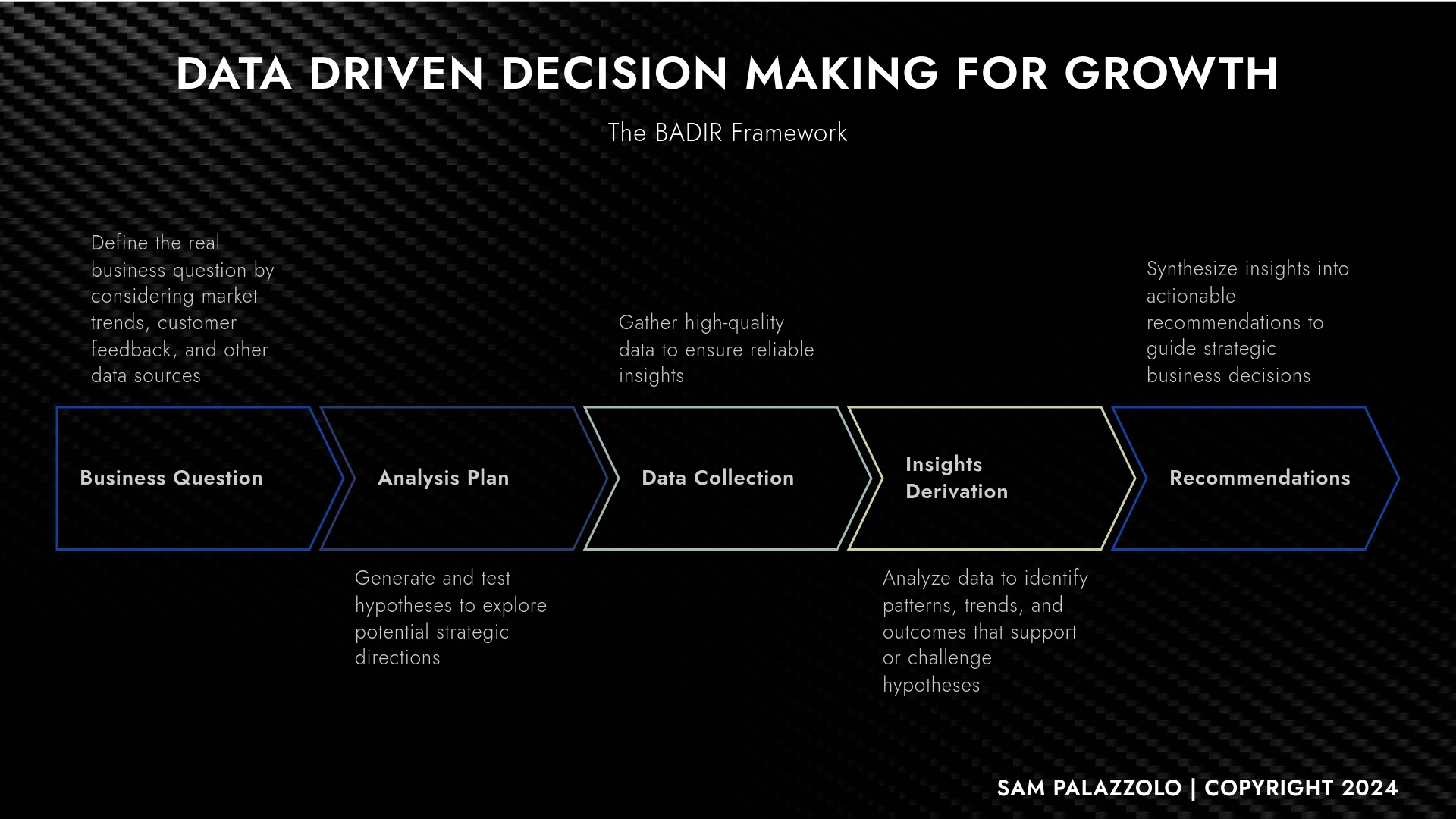
The BADIR Framework, adapted from industry best practices, gives leaders a 5-step roadmap:
-
Business Question
Define the real strategic question. No vague goals—get specific and tie it to market signals or customer friction. -
Analysis Plan
Build and pressure-test hypotheses before diving into data. This prevents “fishing” for insights and aligns teams on what success looks like. -
Data Collection
Collect clean, high-quality data from integrated sources. Prioritize governance, automation, and integrity. -
Insights Derivation
Move beyond dashboards. Analyze for patterns, test hypotheses, and prioritize business-relevant findings. -
Recommendations
Convert insight into action. Focus on outcomes that are measurable, strategic, and stakeholder-aligned.
Whether you’re launching a product, planning expansion, or trying to reduce churn, BADIR ensures your decisions are anchored in evidence—not anecdotes.
REAL WORLD EXAMPLE
A client in the health-tech space came to us with stagnant user growth despite years of internal reporting and analytics investment. Their marketing team insisted they were data-driven—but they couldn’t agree on what success looked like, let alone how to measure it.
We applied BADIR:
-
Business Question: Why were trial-to-paid conversion rates dropping despite stable traffic?
-
Analysis Plan: Hypothesis: Users weren’t seeing value early enough. We mapped first-session behaviors to long-term conversion.
-
Data Collection: Pulled behavioral data from Mixpanel, onboarding survey responses, and NPS scores.
-
Insights Derivation: Users who saw “Setup Complete” within 7 minutes converted 2.6x more.
-
Recommendations: Rebuilt onboarding UX to shorten time-to-value and emphasized “quick wins.”
Result? 38% uplift in paid conversion within 90 days—without changing ad spend or pricing.
REAL STRATEGIES. REAL RESULTS.
If you’re scaling, decisions get riskier and timelines shrink. “Hope it works” is no longer a strategy.
Data should be your most powerful ally—not a source of second-guessing.
With BADIR, you don’t just collect information—you shape it into confident, profitable action.
Sam Palazzolo
Real Strategies. Real Results
PS – Here’s how I can help right here/right now as we enter H2 2025:
1 – Catalyst Audit – Identify if your growth plan is globally ready (and where it’s likely to break).
2 – Catalyst Board – Join an elite peer group navigating similar international scaling challenges.
3 – Catalyst Strategy Session – A focused 1:1 engagement to get your global expansion plan aligned and actionable.
Email me at [email protected] to find out more.



Responses