Back when I worked at GM/Saturn, we were ramping up to launch the new vehicle line. Engineering was ahead of schedule. Marketing was buzzing. Dealers were salivating.
But there was one problem — the supply chain couldn’t keep up.
We had a single supplier producing a key component. They hit a snag. And just like that, the entire production line froze. Cars weren’t getting built. Dealers weren’t getting deliveries. Customers weren’t getting product.
We had all the growth momentum in the world — and it stalled on a dime because the supply chain didn’t scale with it.
That moment stuck with me. And even though that was 30+ years ago, scenarios like it play out today across companies daily.
According to McKinsey, 91% of supply chain leaders say they need to build more resilience, but only 17% feel their current systems are up to the task. That delta? That’s where growth dies.
Let’s fix that!
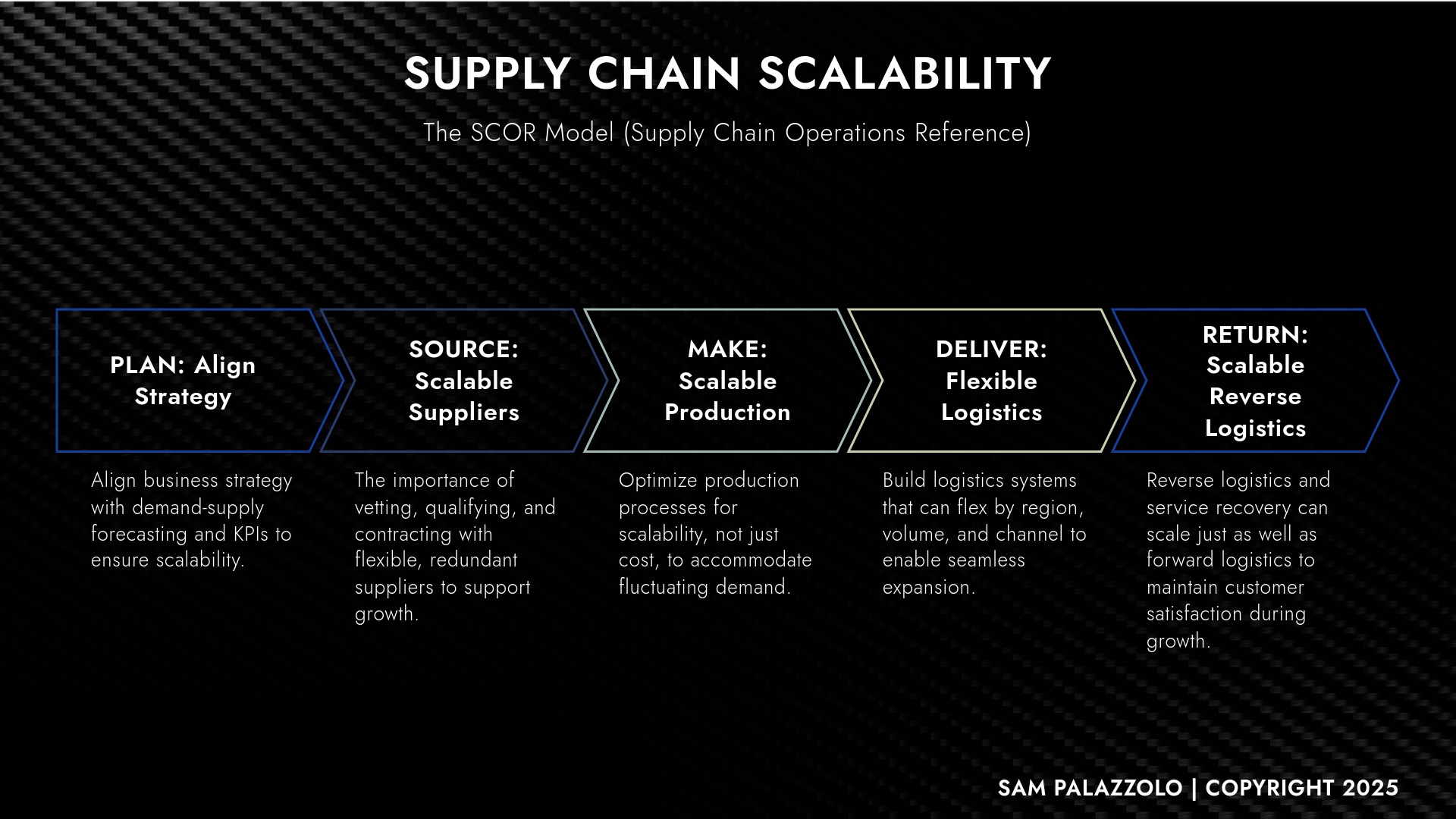
THE SCOR MODEL FOR SUPPLY CHAIN SCALABILITY
Here’s the simple truth: a scalable supply chain isn’t a luxury — it’s your growth infrastructure.
That’s where the SCOR Model (Supply Chain Operations Reference) comes in. It’s a modular, battle-tested framework that aligns every piece of your operations with your growth plan.
Here’s how it breaks down:
-
PLAN: Align business strategy with demand-supply forecasting and KPIs.
→ Is your supply chain scaling with your sales forecast? -
SOURCE: Build flexible, redundant supplier relationships.
→ If one vendor fails, does your business fail too? -
MAKE: Optimize production for scalability, not just cost.
→ Can you flex up production without sacrificing quality or control? -
DELIVER: Enable logistics systems that scale by volume, geography, and channel.
→ Your growth shouldn’t be bottlenecked by delivery limitations. -
RETURN: Reverse logistics must scale with growth.
→ Don’t forget the impact of service, repairs, and returns on brand trust.
“The SCOR model helps you measure, standardize, and scale — across sourcing, production, logistics, and customer satisfaction. It’s the framework Fortune 500s use, and startups can apply today.”
— Source: SupplyChainPlanning.ie citing HBR
REAL-WORLD EXAMPLE: THE 6-MONTH BACKLOG THAT ALMOST KILLED GROWTH
A client of mine had built a category-defining product — one problem: they had a single international supplier, a production lead time of 90 days, and no backup plan.
They scaled sales faster than their supply chain could handle.
Result? A 6-month order backlog, lost momentum, and a customer support nightmare.
We applied the SCOR model:
-
Rebuilt supplier relationships with redundancy
-
Shifted key logistics to flexible regional hubs
-
Implemented KPI-aligned forecasting into planning cycles
Within 90 days, backlogs dropped by 70%. Six months later, they were operating at 2x capacity with no delays.
REAL STRATEGIES. REAL RESULTS.
You don’t rise to the level of your ambition. You scale to the level of your systems.
Supply chain scalability isn’t a “someday” project. It’s a now priority. If you don’t audit it, optimize it, and align it with your growth, it’ll become the ceiling on your success.
Start where others stall.
That's it for this week...
Sam Palazzolo
Real Strategy. Real Results.
—
Three ways we can work together:
Want to assess your operational scalability?
Get the Catalyst Assessment — a strategic tool that helps leaders diagnose gaps across my 5 Pillars - 94 Pylons.
Ready to be part of an Elite Growth Community?
Apply for The Catalyst Board — a private executive board for leaders scaling from $10M to $1B+. (Two tiers available. Limited seats.)
Need help sharpening Execution Strategy?
Let’s get into the trenches together. The Executive Strategy Catalyst Program is designed for leaders like you. (Three weeks a month. 60 minutes a session. All strategy, no fluff.)
Email me at [email protected] for information.
—


Responses