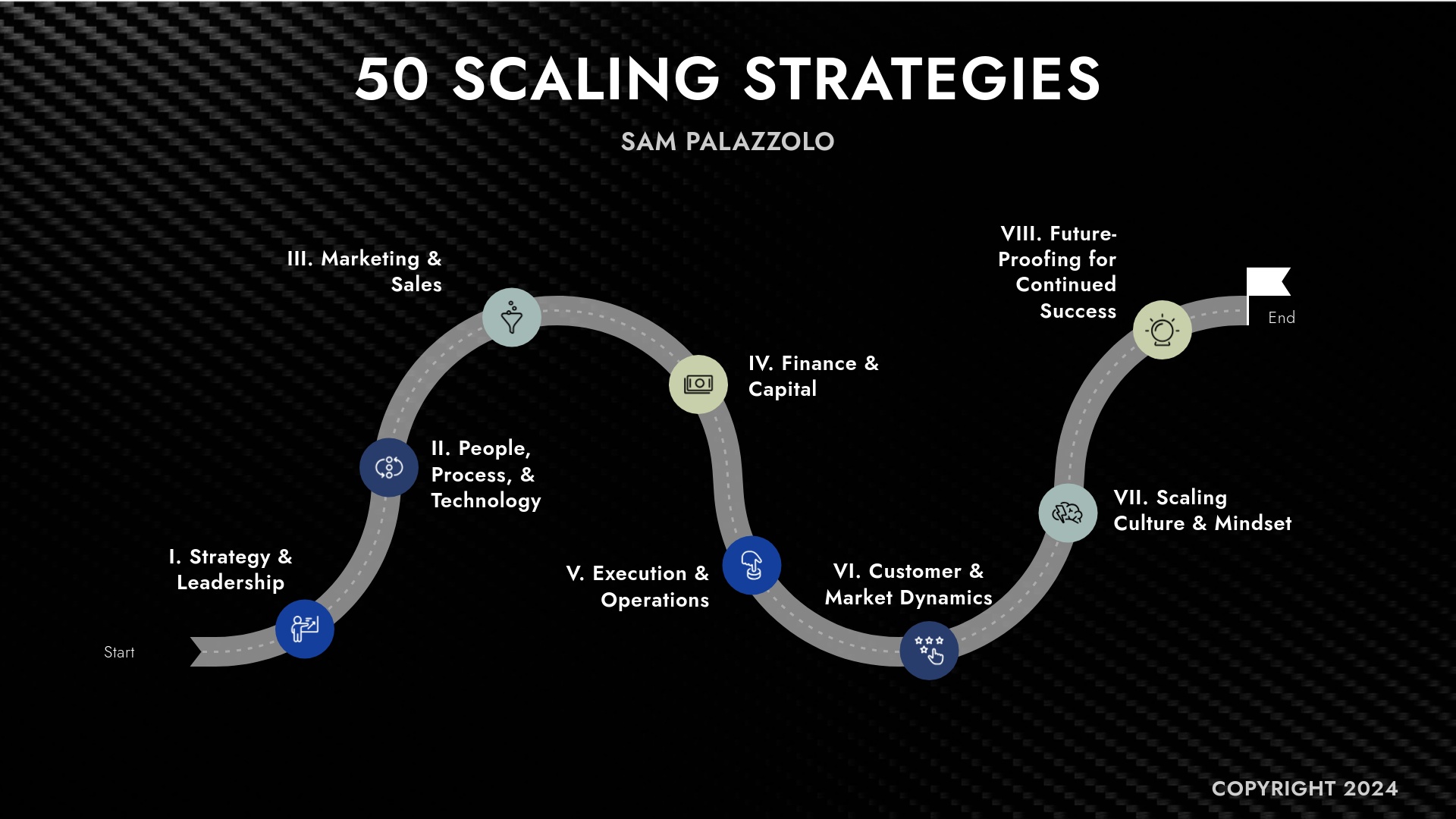
Execution & Operations: Why Growth Stalls Without Operational Efficiency
Most scaling challenges don’t start with vision or strategy—they start with execution. Or rather, the lack of it!
Back when I worked for Toyota/Lexus, operational precision wasn’t optional—it was the culture. I saw firsthand how Toyota's Quality Management (TQM) dictated even a minor process breakdown—a $1 part out of sync—could halt production across a multimillion-dollar line. But I also saw how a well-designed, waste-free system could scale without friction, without fail.
That experience shaped how I lead and scale businesses today.
And it’s why Part V of the 50 Scaling Strategies roadmap focuses on Execution & Operations—the real engine behind sustainable growth. As your business expands, so does complexity. Without tight execution and a strong operational backbone, growth doesn’t accelerate—it collapses under its own weight.
This week’s focus? Operational Efficiency—the overlooked multiplier behind reliable, scalable execution!
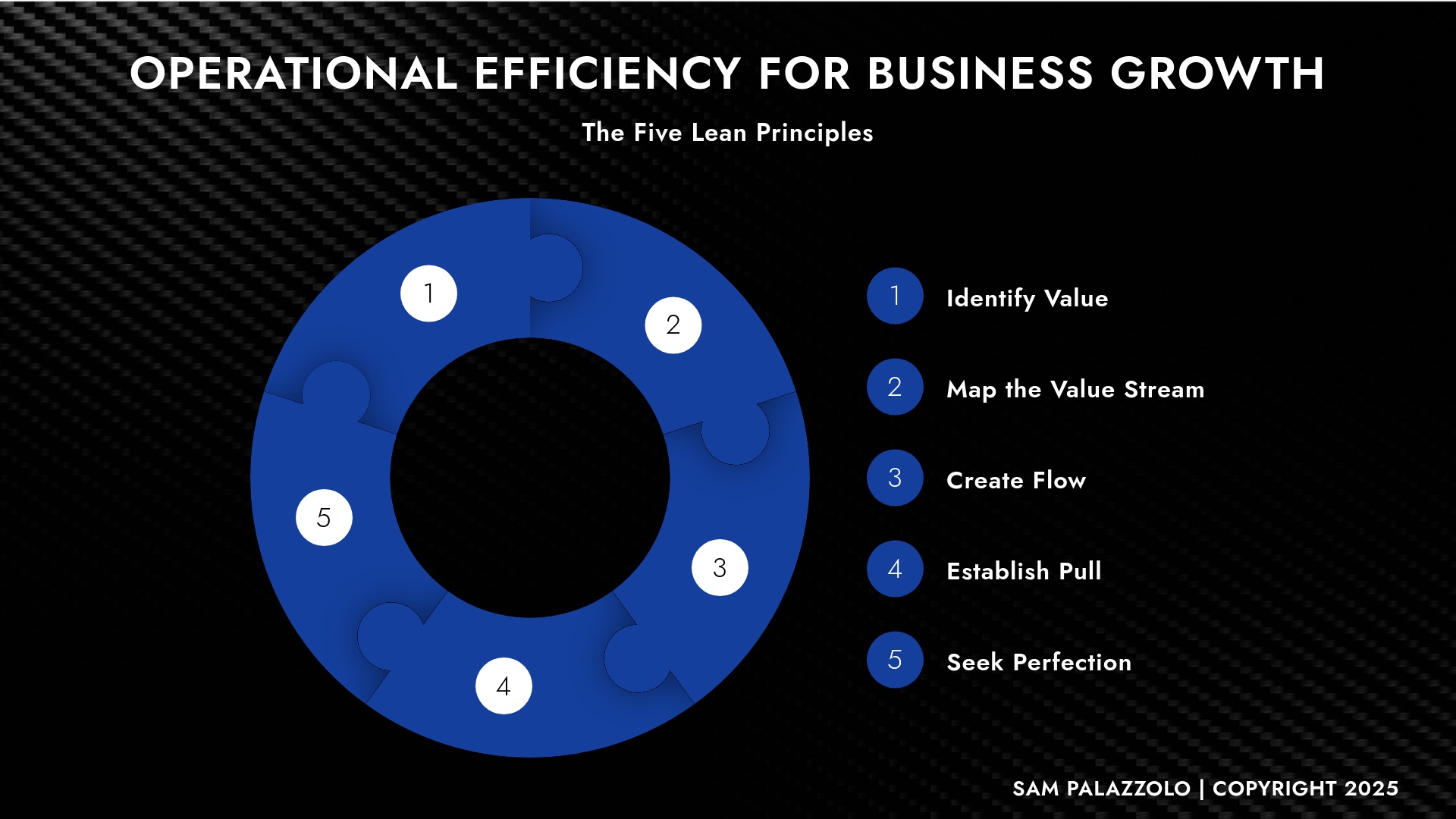
The 5 Lean Principles: From Toyota’s Factory Floor to Your Boardroom
This isn’t a borrowed framework for me—it’s one I lived!
During my time at Toyota/Lexus, these principles weren’t buzzwords. They were the standard. I’ve since adapted them across industries—from high-growth tech to mid-market turnarounds. They work. Here’s how:
-
Identify Value
Understand what your customer truly values—not what you think they should. Remove everything else. -
Map the Value Stream
Visualize the end-to-end process. Find the waste, the duplication, the wait times. Then cut them. -
Create Flow
Design work to move continuously—no stalls, no bottlenecks. Clean up the path from start to finish. -
Establish Pull
Build systems that respond to real-time demand. Don’t overbuild. Don’t assume. Let the customer drive production. -
Seek Perfection
Operational excellence is never “done.” Refine continuously. Make improvement a cultural habit.
These principles helped Toyota become a global benchmark in operational excellence. They can help your organization become one in its space, too.
Real World Example
One leadership team I worked with was facing stalled delivery timelines—despite doubling headcount and investing in tools. The assumption? “We need more people.”
But when we mapped their process—just Post-its on a whiteboard—it revealed something else: five approval loops, two unassigned handoffs, and no clear owner for onboarding.
The problem wasn’t bandwidth. It was friction!
We applied the TQM Lean Principles to streamline ownership, cut out duplicate steps, and tie actions to actual customer triggers. In 45 days, delivery time dropped by 40%, and team morale spiked—because chaos was replaced with clarity.
Efficiency isn’t about moving faster. It’s about removing what slows you down.
Real Strategies. Real Results.
Execution isn’t magic. It’s mechanics. Operational efficiency is how you convert bold strategies into real outcomes—on time, on budget, and at scale.
As you move through Part V of the '50 Scaling Strategies' roadmap, ask yourself:
"Do we have a growth strategy… or a growth system?"
Because vision without execution is just potential. And potential doesn’t scale. Systems do.
If you're ready to build the operational backbone that makes scaling sustainable:
→ Join the Sales & Marketing Acceleration Program
An AI-powered platform that compresses sales cycles by 25–30% and replaces the work of 5 BDRs.
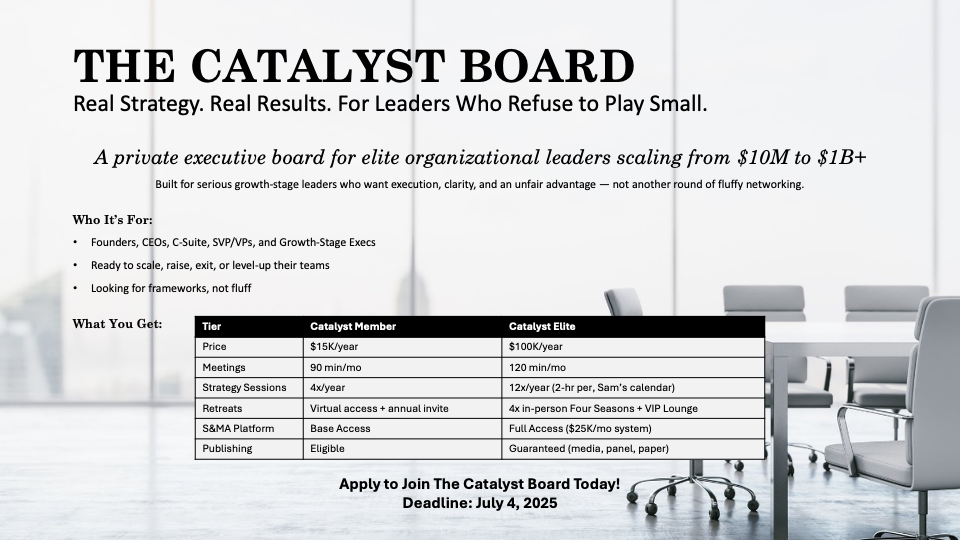
→ Apply for the Catalyst Board
A private executive board for leaders scaling from $10M to $1B+. No fluff—just clarity, strategy, and unfair advantages.
Deadline: July 4, 2025.
View Catalyst Board Details (see below & reply to this email with interest)
—
Sam Palazzolo
Real Strategies. Real Results.



Responses