Every leader says the same thing:
“I’m building something big.”
But few can answer this critical question:
“What’s your endgame?”
According to the Exit Planning Institute, 83% of business owners have no formal exit plan—even though 100% of them will eventually exit. And PwC reports that 75% of owners regret their exit within a year, usually because they failed to plan for what comes next.
I’ve worked with leaders who scaled companies from $10M to $1B+—but the ones who got paid what they were really worth were the ones who started planning for the exit before they thought they needed to.
So this week, let’s get real about exit strategy!
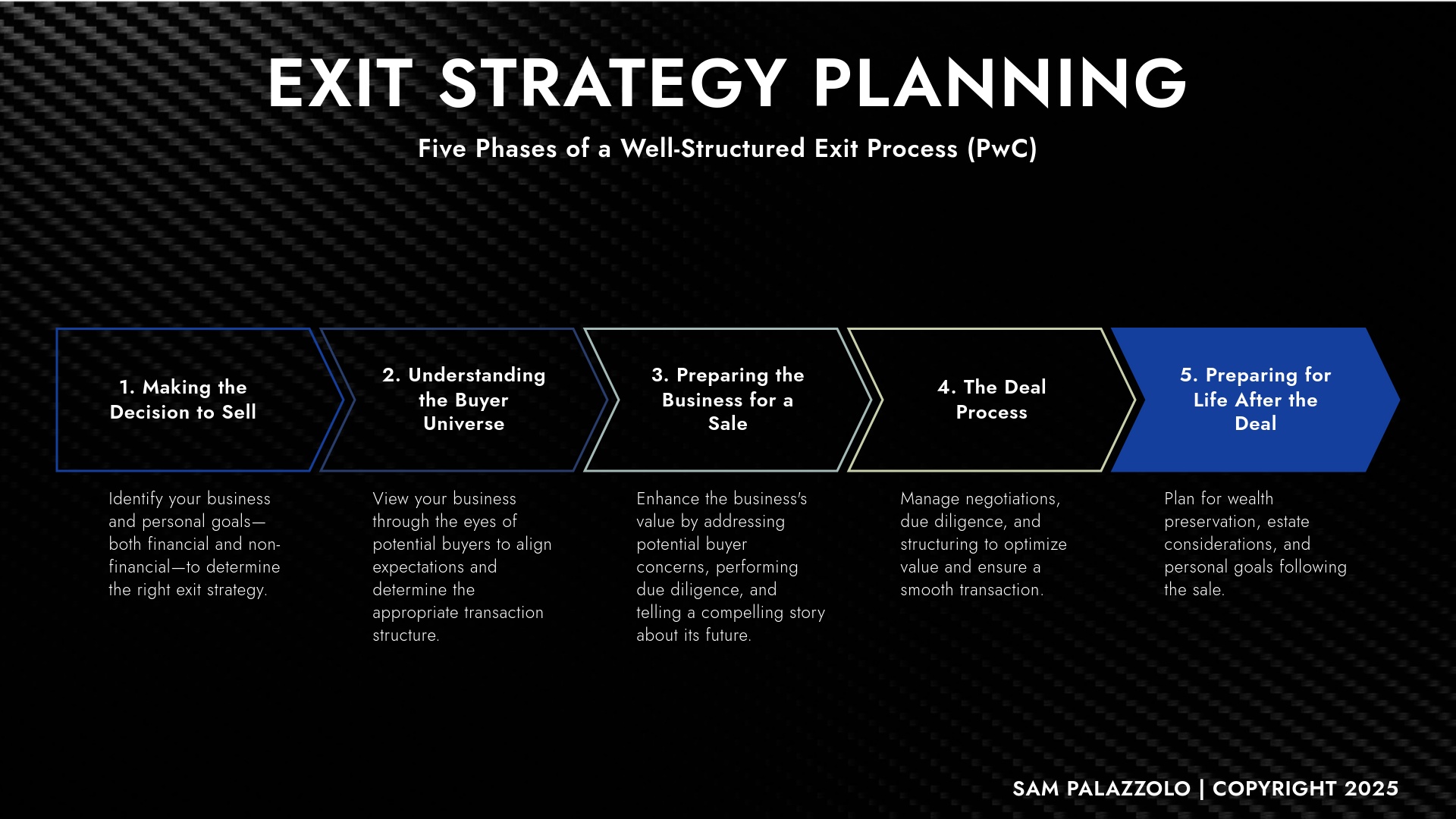
The Five Phases of a Well-Structured Exit (PwC)
Based on PwC’s trusted model, these five steps will help you prepare, preserve value, and exit on your terms:
1. Making the Decision to Sell
Align your personal and business goals—financial, legacy, or lifestyle—so the transaction delivers real fulfillment.
2. Understanding the Buyer Universe
Know who you’re building for. Different buyers (strategic, financial, internal) want different things—and value you differently.
3. Preparing the Business for a Sale
Clean up your books. Streamline operations. Reduce dependencies. Create a compelling story about what comes next.
4. The Deal Process
Structure the transaction to maximize valuation, minimize taxes, and support a smooth transition.
5. Preparing for Life After the Deal
Think beyond the wire transfer. This is about wealth preservation, estate planning, and designing the next chapter.
Real World Example
Let’s say you’ve spent 15 years scaling your company, and someone’s finally interested in buying. You scramble to get your books in order, clean up your operations, and figure out what the company’s worth. The buyer points out issues you hadn’t considered—customer concentration, lack of leadership depth, unclear product roadmap.
They offer 30% less than expected.
Now imagine you had planned two years earlier.
You diversified revenue, delegated leadership, aligned with buyer expectations—and had a clean, compelling story ready.
That deal would have closed at full price—or higher.
The difference? Strategic preparation.
Real Strategies. Real Results.
Exit strategy isn’t about timing the market.
It’s about alignment, optimization, and vision.
Whether you’re aiming for acquisition, transition, or IPO—this isn’t just a finish line. It’s your final legacy move. Start now, and you’ll scale smarter—with buyers and successors watching every step you take.
That's all for this week...
Sam Palazzolo
Real Strategies. Real Results.
P.S. - Let’s Scale Intentionally—Then Exit Strategically!
- Access my 'Sales & Marketing Acceleration Program' -> https://javelininstitute.org/sales-marketing-acceleration-program/
- Explore the CEO Catalyst Program -> https://sampalazzolo.com/



Responses