Read Time: 5 Minutes
When Growth Becomes a Trap
There’s something particularly frustrating about growing a business… only to realize you're stuck because of cash. I’ve seen it—and felt it—too many times.
A few years back, I was advising a company scaling fast. Headcount was doubling, new clients were flowing in, and excitement was sky-high. Then the CFO dropped a bomb:
“We’ve got 30 days of cash.”
What? How does that happen?? Simple - Growth outpaces liquidity!
And they’re not alone. Research shows 82% of businesses fail due to cash flow problems. Meanwhile, 60% of large-company CFOs admit they delay strategic investments because of cash constraints.
It doesn’t matter how big or small you are. If you’re scaling without a reserve plan, you're playing offense with no defense. And eventually, the market hits back.
Let's get into it...
The Framework: Scaling Without Sinking
Let’s ground this in a practical solution.
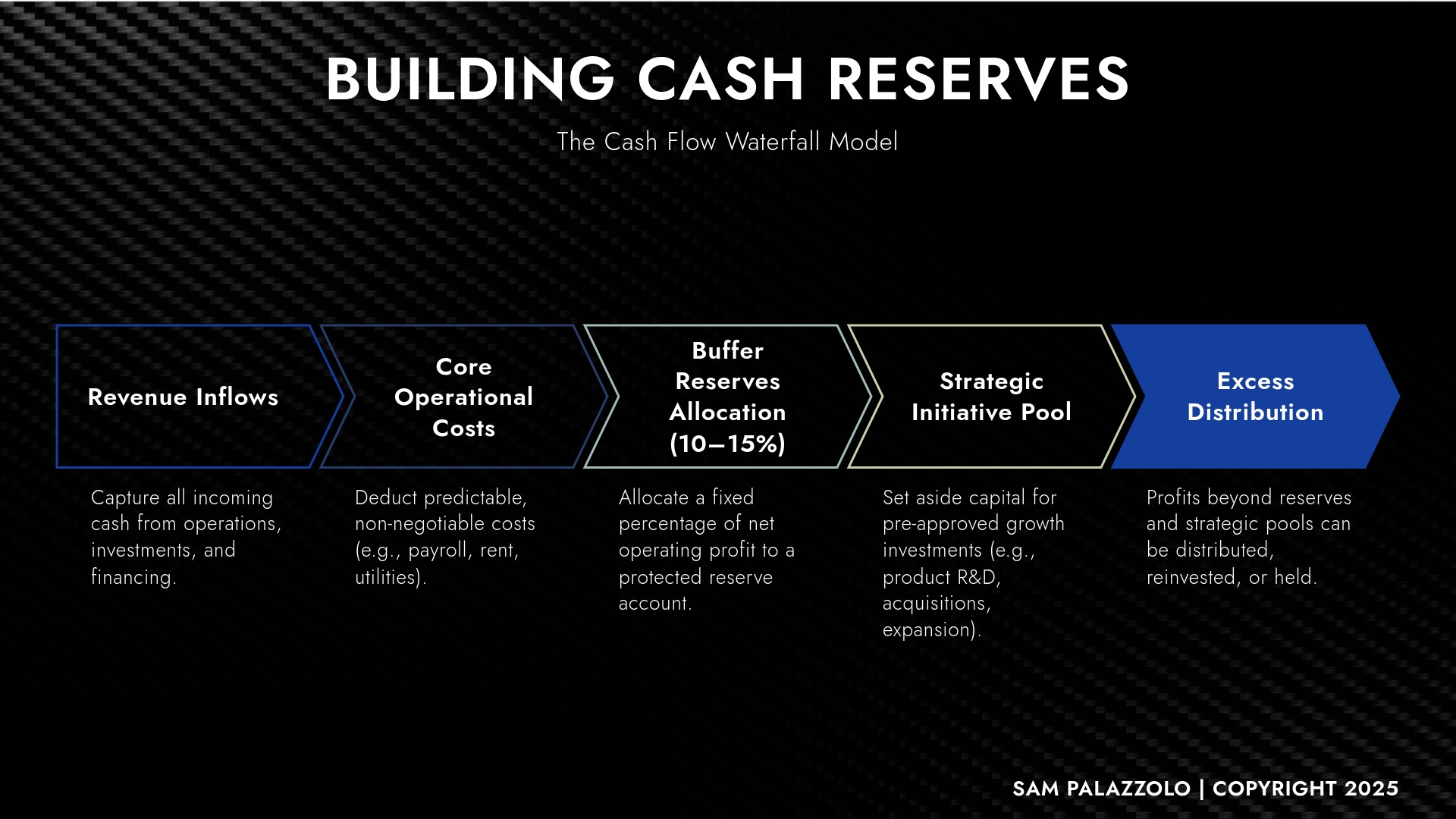
One model I coach clients through is the Cash Flow Waterfall, inspired by Harvard Business Review's work on strategic liquidity. It’s not flashy—but it works.
Here’s how to use it:
-
Track Your Inflows First
Before planning where your money goes, get clear on what’s coming in—revenue, capital, financing. -
Cover the Basics
Allocate for fixed and essential costs: payroll, rent, tech. This is your baseline. -
Build Your Reserve—Every Quarter
Allocate 10–15% of net operating profit into a protected reserve account. Don’t touch it unless it's an emergency or opportunity. -
Fund Strategic Growth
Want to explore new markets, invest in product, or make acquisitions? Set aside funds in a separate pool—not your reserve. -
Only Then—Distribute Profits
After the above, distribute excess earnings or reinvest them into the core business. Never before.
Simple to outline. Powerful when executed. And yet, most leaders skip Step 3 entirely.
Real World Example
I worked with a leadership team who’d just secured a massive enterprise contract—biggest in company history. Naturally, they were eager to scale: new hires, new tech stack, new office lease.
But we paused and ran the Cash Flow Waterfall. Turns out, after subtracting necessary operating expenses, they had less than 5% left over to fuel growth. And they were planning to spend 3x that.
We restructured their plan:
-
Slowed hiring
-
Created a six-month reserve
-
Funded strategic growth through phased reinvestment
Twelve months later, they’re still growing—this time with control. That enterprise contract? It’s now a marquee case study.
Real Strategies. Real Results.
Too many leaders treat cash as an afterthought. In reality, it’s your runway. It determines how far—and how fast—you can go.
The Cash Flow Waterfall isn’t just about protection. It’s a strategy for growth on your terms. Because opportunity doesn’t wait, and you need reserves to act when it strikes.
If you’re scaling and haven’t built a reserve strategy, now is the time to get ahead of it.
That's all for this week...
– Sam Palazzolo
Real Strategies. Real Results.

📌 I’ll be walking through this and other practical frameworks during our next Sales & Marketing Acceleration Briefing—where we show how to compress the sales cycle by 25–30% and generate ROI in 60–90 days. Register here: https://www.linkedin.com/events/aiisn-tthesales-marketingstrate7313694320455217153/theater/
📌 And for leaders building their full strategic blueprint, our next CEO Catalyst Program kicks off soon. Seats are limited. Find out more here: https://sampalazzolo.com/





Responses