“We’re adding new customers… So why aren’t we growing?”
That was the question a leader asked me recently—frustrated and confused. Revenue was up. CAC was down. And yet—growth felt… stagnant.
When I dug deeper, the issue was clear: the organization was obsessed with acquisition and had unintentionally neglected everything post-sale.
No formal success strategy.
No tracking of Net Promoter Score (NPS) or Customer Satisfaction Index (CSI).
No effort to turn good experiences into real advocacy.
“You don’t have a sales problem,” I told them.
“You have a customer success problem.”
This week, we’re looking at Customer Success Management (CSM)—the system that turns first-time buyers into lifelong brand champions.
Let's get into it!
Why CSM Is the Secret to Sustainable Growth
Customer Success is more than support—it’s a proactive growth lever.
And the numbers don’t lie:
-
86% of buyers are willing to pay more for a great customer experience—yet only 1% feel their expectations are consistently met. (PwC)
-
75% of SaaS revenue comes from existing customers—not new ones. (Gainsight)
-
Companies that prioritize customer success see a 91% higher year-over-year retention rate. (Deloitte)
-
Businesses that improve customer experience (CX) can increase revenue by 10% to 15% and lower service costs by 15% to 20%. (McKinsey)
That’s not anecdotal—that’s operational advantage.
And if you want to tap into that upside, you need a framework to do it. That’s where SPARC comes in.
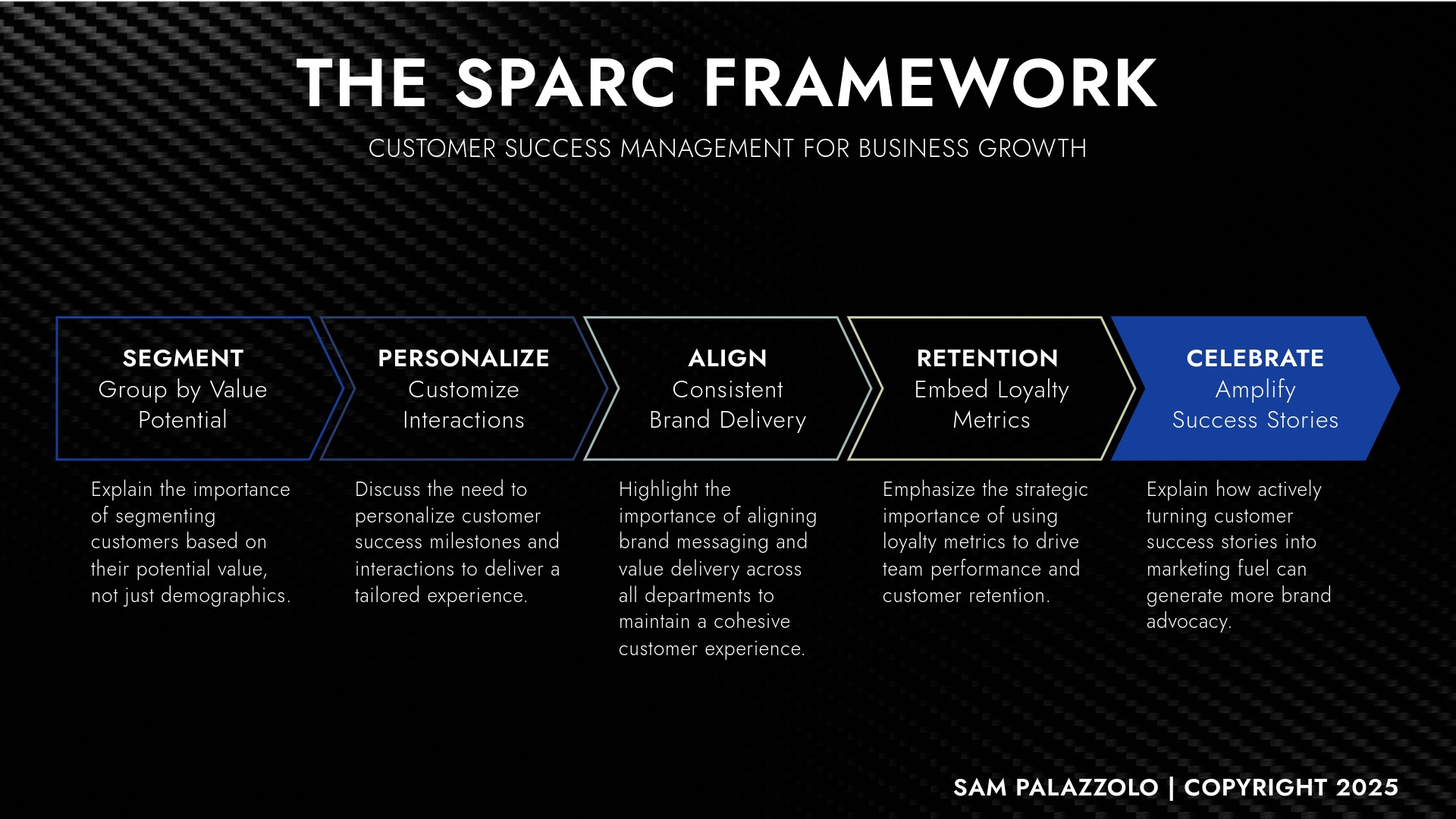
The SPARC Framework: Your System for Scalable Success
SPARC* is a five-part model I’ve used with scaling teams across industries to turn customers into champions—while aligning teams internally.
S — Segment
Group customers by potential value—not just by size or vertical.
▸ Focus your resources where retention and advocacy have the highest return.
P — Personalize
Tailor success milestones, usage reviews, and outreach to the individual.
▸ Leverage CSI and behavioral data to deepen emotional engagement.
A — Align
Unify your brand, product, and support teams around shared success metrics.
▸ Sync on NPS, adoption, and expansion KPIs to avoid message dilution.
R — Retention
Make loyalty a measured outcome.
▸ Integrate churn, renewal, and upsell metrics into performance reviews.
C — Celebrate
Turn happy customers into vocal advocates.
▸ Use testimonials, spotlight features, and referrals as scaling levers.
* Kriss, P. (2014, August 1). The Value of Customer Experience, Quantified. Harvard Business Review. Retrieved from https://hbr.org/2014/08/the-value-of-customer-experience-quantified
Real World Example
A fast-growing company I advised was dealing with slumping renewals—even though acquisition was strong. Their CX was fragmented. No standardized success process. NPS was sitting at 18 and trending downward.
We implemented SPARC:
-
Segmented accounts by expansion potential
-
Personalized onboarding and quarterly business reviews
-
Rolled out a unified CX playbook aligned with retention KPIs
-
Elevated NPS tracking and feedback loops to C-level dashboards
-
Created a public-facing “Customer Spotlight” initiative
The result?
-
NPS jumped from 18 to 47 in 90 days
-
CSI scores rose 22%
-
Referral leads increased 3x
-
Annual revenue from existing customers grew by $2.3M
The takeaway?
They didn’t need more leads—they needed more success.
Real Strategies. Real Results.
If you're serious about scaling, don’t just count the customers coming in—track how well you’re helping them win.
Customer Success Management brings together CX, CSI, NPS, advocacy, and retention into one coordinated engine. It keeps your promises, sharpens your brand, and earns you the kind of loyalty that money can’t buy.
To sustainable growth—
Sam Palazzolo
Real Strategies. Real Results.
PS - Curious what your Sales & Marketing teams could accomplish with a Deloitte-trained strategist and a bit of AI? Join me for an Executive Briefing on Thursday, April 3 @ 12 noon EDT.
To register, email: [email protected]



Responses