Read Time: 5 Minutes

The Power of Partnerships: A Scaling Catalyst
Imagine you’re at the helm of a growing company, poised for expansion, but facing roadblocks—whether it’s market access, resources, or innovation capacity. You could go it alone, investing heavily in organic growth. Or, you could leverage a strategic partnership—collaborating with another organization to accelerate growth, reduce costs, and expand your reach faster and more efficiently than building from scratch.
History tells us that the world’s biggest companies didn’t scale alone. Apple’s partnerships with suppliers like Foxconn, Nike’s collaborations with athletes and tech companies, and Starbucks’ strategic alliances with retailers like PepsiCo all fueled their global dominance.
If you’re looking to scale smart, alliances are a proven pathway to faster success.
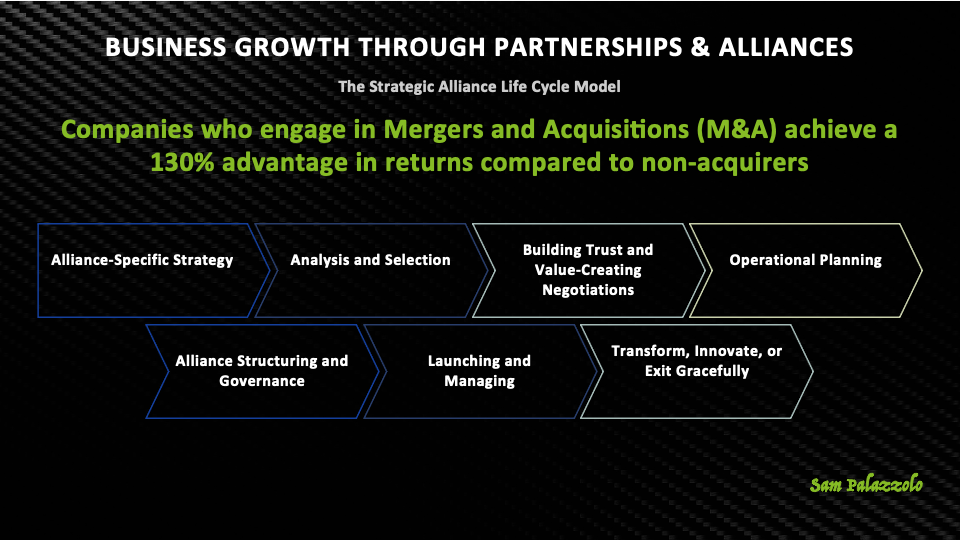
The Strategic Alliance Life Cycle: A Playbook for Success
Strategic partnerships aren’t just about shaking hands and signing contracts. They require a structured approach to ensure long-term success. That’s where the Strategic Alliance Life Cycle comes in—a framework that guides leaders through the essential phases of forming and managing successful partnerships.
Companies that engage in Mergers & Acquisitions (M&A) see a 130% advantage in returns over non-acquirers. But beyond M&A, structured partnerships increase revenue, lower costs, and enhance innovation by leveraging shared strengths.
The 7 Stages of the Strategic Alliance Life Cycle
Forming a successful strategic alliance isn't just about finding the right partner—it’s about structuring, managing, and evolving the relationship to drive long-term success. Too often, partnerships fail due to misaligned objectives, poor governance, or lack of strategic oversight. That’s why following a structured approach is critical.
The Strategic Alliance Life Cycle from the Association of Strategic Alliance Professionals (ASAP) provides a 7-stage roadmap that ensures partnerships are built on clear objectives, strong governance, and continuous adaptation. Whether you’re entering a joint venture, reseller agreement, or co-branded initiative, these stages help maximize growth, innovation, and competitive advantage while minimizing risk.
Here’s how to navigate each stage effectively:
1️⃣ Alliance-Specific Strategy:
- Define how the partnership aligns with your business objectives.
- Establish systems and processes to support collaboration.
- Facilitate alignment between senior management and alliance partners.
2️⃣ Analysis & Selection:
- Conduct thorough due diligence on potential partners.
- Assess strategic, operational, and cultural fit before formalizing agreements.
- Identify partners that complement your capabilities.
3️⃣ Building Trust & Value-Creating Negotiations:
- Establish mutual goals and define the value proposition early.
- Align financial expectations and risk-sharing agreements.
- Foster a transparent and collaborative negotiation process.
4️⃣ Operational Planning:
- Develop execution roadmaps with clear performance metrics.
- Define resource allocation, timelines, and governance structures.
- Implement tools to track and optimize alliance performance.
5️⃣ Alliance Structuring & Governance: (🚀 Newly added!)
- Establish a governance framework with decision-making protocols.
- Define legal agreements that allocate risks and rewards equitably.
- Appoint key alliance leaders to oversee execution and long-term management.
- Create joint steering committees or advisory boards for alignment.
6️⃣ Launching & Managing:
- Implement governance structures and engage key stakeholders.
- Maintain oversight through regular performance tracking.
- Adjust strategies based on market feedback and alliance success metrics.
7️⃣ Transform, Innovate, or Exit Gracefully:
- Assess performance and identify opportunities for expansion.
- Adapt to changing market conditions by evolving the partnership.
- If necessary, plan an amicable and strategic exit to preserve future collaboration potential.
Successful partnerships are built on structure, trust, and shared value creation—not just good intentions.
Real-World Example: A Tech Firm’s Growth Playbook
Leaders often approach me and share that they're intimidated by M&A. Here's an example of creating a strategic partnership!
A mid-sized company sought to expand its market presence without the high costs of direct customer acquisition. Instead of burning capital on marketing, they partnered with an enterprise consulting firm that served the same target market.
- The consulting firm integrated the SaaS product into its service offerings, increasing software adoption.
- The SaaS company gained access to the consultant’s established network of Fortune 500 clients.
- Both firms co-branded the solution, adding credibility and doubling their potential customer base.
Result? A 200% increase in revenue from enterprise clients in just 12 months—without spending millions on advertising.
This is the power of leveraging alliances strategically!
Real Strategies. Real Results.
Strategic partnerships aren’t just for large enterprises. Whether you’re an SMB, a mid-market company, or a Fortune 500 leader, alliances can unlock untapped potential when structured correctly.
Until next time, scale smarter!
Sam Palazzolo
Want to master business scaling? Get my '50 Scaling Strategies' eBook ($50 Value) for FREE when you subscribe to my newsletter! [Link in BIO or CLICK HERE]




Responses